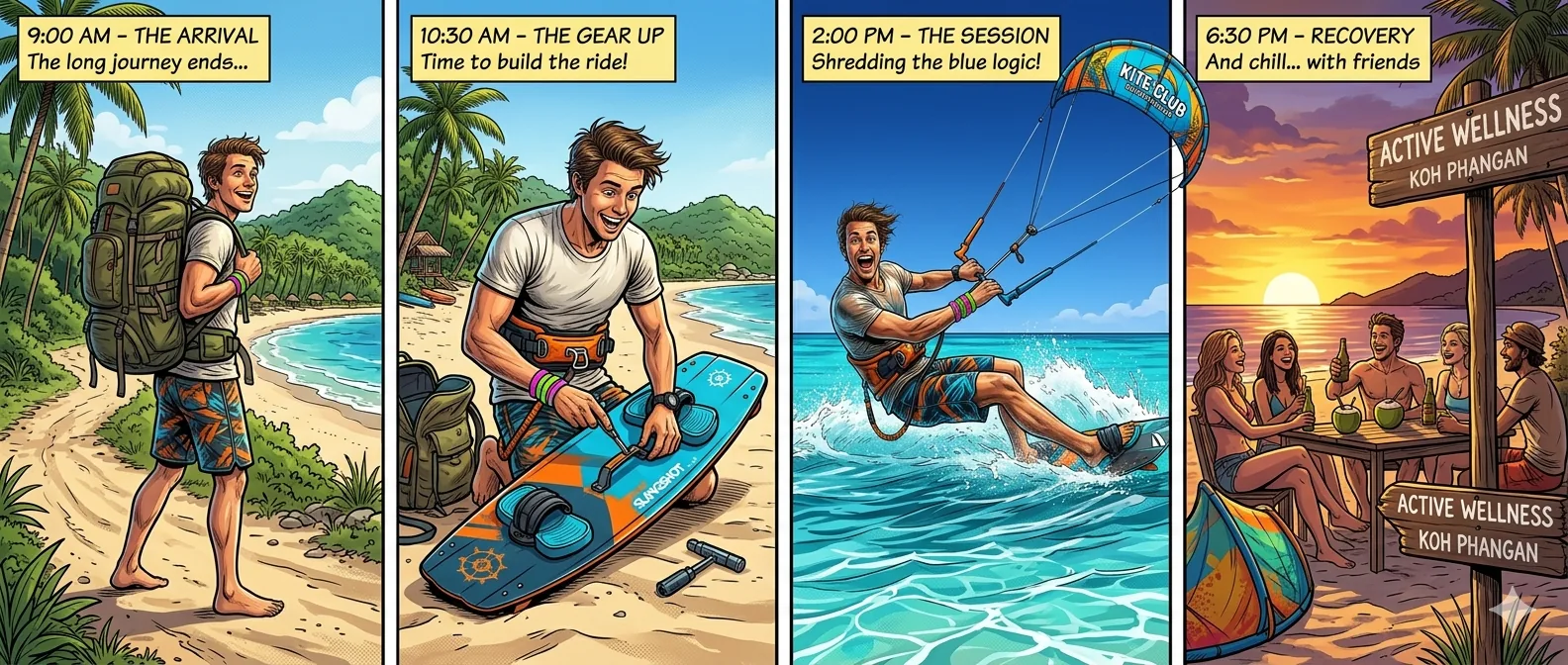
No two kite days are the same, but they share a shape: check the wind, rig, ride, eat, ride again. Here is how that plays out on a February day at Lamai and on a July afternoon at Nathon, from the first forecast check to the last rinse of the kite.
📖 13 min read · Updated May 2026 · By Sergei Sharvarok · Founder & Head Instructor
Visitors often picture kitesurfing as non-stop action. In reality a good kite day has a lot of waiting, watching and small decisions in it, and learning to enjoy that rhythm is part of the sport. To show what it is like on Samui, we follow two days: one in the heart of the winter season on the east coast, and one in the summer season on the west coast.
Two Days, Two Coasts
Samui's wind comes from opposite directions depending on the time of year. From December to April the northeast monsoon reaches the east coast, and we teach at Lamai Beach. From May to October the southwest monsoon takes over, and we move to Nathon Beach, beside Nathon town and the ferry pier. The daily routine changes with the coast — winter days at Lamai give more options, summer days at Nathon usually centre on the afternoon.
February at Lamai: The First Look at the Forecast
The day begins on a phone, with a coffee. Windy or Windguru shows the three numbers that matter: average wind speed in knots, gusts, and direction. Today reads 14 knots rising to 18 by late morning, gusts in the low twenties, northeast. For a beginner that is a comfortable lesson day; for a rider it means a mid-size kite.
The gap between wind and gusts matters as much as the wind itself. Fifteen knots gusting 17 is smooth. Fifteen gusting 25 is lumpy and tiring. A quick look at the sea from the balcony — white caps spreading across the bay, palm fronds leaning steadily — confirms what the app says.
Local Insight
Apps are a guide, not a guarantee. Samui's hills and the heat of the day can shift the breeze by a few knots or a few degrees. Your instructor combines the forecast with what they see on the beach, which is why lesson times are confirmed on the day.
Late Morning: Rigging and the Beach Briefing
At the beach the instructor has already chosen a teaching area, away from swimmers and with clear space downwind. A student on their third lesson helps set up: kite laid out with the leading edge into the wind, pumped until it feels firm, lines unrolled and checked for knots, bar connected the right way round. Every step is part of the curriculum, not a chore before the "real" lesson.
Before anyone launches, the plan for the session is short and specific: today, relaunch the kite from the water on your own and body drag back upwind. The student puts on a helmet with a built-in radio and a buoyancy vest, and the instructor checks the quick-release one more time.
On the Water: A Two-Hour Block
A private lesson is two hours; a group lesson for two students runs three hours, because they take turns. The first twenty minutes are usually the least tidy: the body is still waking up and the kite feels bigger than yesterday. Then something settles. The student stops staring at the kite, starts feeling the pull through the bar, and the corrections coming through the radio begin to land — "a bit less bar", "kite higher", "lead with your front hand".
The moment of the day comes at the end: the kite drops into the water, the student flips it, reverses it to the edge of the window and relaunches it without help. It is not spectacular to watch. It is exactly the skill that makes water starts possible in the next lesson.
Lunch in Lamai
Two hours in the sun and salt water builds an appetite. Lamai has plenty of simple places close to the beach — rice and curry, grilled chicken, fruit shakes — and a long, shaded lunch is part of the day. This is also when the beach turns social. Students compare notes, riders swap stories about the morning, someone shows a shaky phone video of their first proper ride.
If you are travelling alone, this is where the kite trip stops feeling solo. The conversation starts with "what size were you on?" and ends with dinner plans.
Afternoon: Stronger Gusts, Smarter Choices
On many peak days the wind is at its strongest in the early afternoon. Experienced riders size down and enjoy it. For a beginner, the call belongs to the instructor: sometimes the afternoon is perfect for a second session, sometimes it is too gusty to learn well, and the better choice is to rest and come back tomorrow.
That decision is easier to accept when you know why. Learning needs predictable feedback. In very gusty wind the same movement produces different results each time, and the student cannot tell which mistakes are theirs. Waiting an hour, or a day, often saves time overall.
Evening: Rinse, Dry, Debrief
As the light softens, the day winds down. Kites are rinsed if they need it, dried in the shade, rolled from the wingtips so the bladders are not creased, and packed away. Lines are wound neatly onto the bar. It takes ten minutes and saves many more the next morning.
The debrief is short and honest: what went well, what still needs work, what the plan is for tomorrow. Many students scribble a few notes on their phone. Then it is sunset, a shower and dinner in Lamai — and, almost always, another look at the forecast.
July at Nathon: A Different Rhythm
A summer day on the west coast starts slower. Mornings are often calm, and the southwest breeze tends to build later, usually around 10–18 knots and more variable than winter at Lamai. That changes the shape of the day.
- Morning: flat water is perfect for other things — a 30-minute e-foil intro (2,000 THB), a SUP hour (400 THB) or a kayak along the shore (500 THB per hour).
- Midday: lunch in Nathon town, a walk past the old shophouses and the pier.
- Afternoon: the kite or wing lesson, timed for the best part of the breeze.
- Evening: sunset over the water on the west coast — one of the nicest parts of a summer trip.
Summer is less predictable, so plan a spare day or two in a course. On days when the wind is present but light, a wing foil intro (4,000 THB, 2 h) can be a good alternative to a kite lesson.
Reading the Numbers
| Forecast shows | For a beginner lesson | For an independent rider |
|---|---|---|
| Under 10 kts | Too light; switch to e-foil, SUP or rest | Big kite or foil, or a day off |
| 12–20 kts, steady | Ideal learning conditions | Good all-round session |
| 20+ kts or big gusts | Often postponed; instructor decides | Smaller kite, extra care in traffic |
| Thunderstorm risk | No lesson | Stay off the water |
Who You Share the Beach With
A kite beach is a small community. On any day you will see students on their first lesson, returning riders renting gear after a Refresh lesson, couples doing a group course together and the occasional wing foiler cruising past. People come from all over the world, and lessons are available in English, Russian, Arabic, German and Ukrainian.
Etiquette is simple: ask before launching, give way according to the rules you learned in lesson one, and help someone land their kite when they wave. The rest follows naturally.
What We Provide and What You Bring
| The school provides | You bring |
|---|---|
| Kite, bar and lines, board, harness | Swimwear and a long-sleeve rash vest |
| Helmet with radio, buoyancy vest | Sunscreen, lip balm, sunglasses on a strap |
| An IKO-certified instructor — Sergei or Abdulla, both IKO Level 3 | Water, snacks and a bit of patience |
Once you can ride on your own, you can rent a full kite set (kite, bar, board and harness) for 2,000 THB per hour, 3,500 THB for two hours, 4,500 THB for three, or 5,000 THB for the day.
A Rider's Day Looks Different
Everything above follows a student. Someone who already rides independently experiences the same day with more freedom and different worries. They are not waiting for an instructor to call the session; they are deciding for themselves whether the gusts are within their comfort zone, which kite size to rig and how long to stay out.
Returning riders who have had a long break often start the trip with a 2-hour Refresh lesson (3,500 THB). It is a quick way to check the safety system, relaunches and self-rescue in local conditions before renting gear. After that, a rider's day tends to have two sessions: one when the wind first fills in and one later, with a long lunch between. On lighter days many bring a wing or try the e-foil rather than forcing a big kite.
The biggest difference is responsibility. With no one on the radio, the rider has to notice when the wind is increasing, when the beach is getting crowded and when they are tired. Knowing when to come in is a skill that separates experienced kiters from beginners more than any trick does.
Five Small Things That Make the Day Better
- Reapply sunscreen at lunch. Wind hides how strong the sun is; the back of the neck and the tops of the feet burn first.
- Bring more water than you think. Two hours in salt water and heat is dehydrating, and headaches in the afternoon are usually thirst.
- Keep a light grip. Holding the bar too tightly tires your forearms and makes your steering jerky.
- Rest before you are exhausted. Most beginner mistakes happen in the last twenty minutes of a long day.
- Keep your evening flexible. If tomorrow's forecast changes, you may want an early start — or a lie-in.
Frequently Asked Questions
What time of day is best for kitesurfing on Koh Samui?
It depends on the season. At Lamai (December–April) the NE monsoon often gives good wind from late morning, with more choice of times in the peak months. At Nathon (May–October) the SW breeze usually builds later, so afternoons tend to be best.
How long is a kitesurfing lesson?
A private lesson is 2 hours. A group lesson for two students with one instructor is 3 hours, because you take turns flying the kite. Courses are made of several of these blocks over consecutive days.
Can I do two sessions in one day?
Sometimes, if the wind is good and you have the energy. Beginners usually learn best from one focused lesson a day with a proper rest, and your instructor may advise against a second session in very gusty conditions.
What happens if the wind is too strong or too light?
The instructor decides on the beach. The lesson may be shortened, moved to a better time of day or postponed to another day, and you keep your lesson hours. Calm days are good for e-foil, SUP or kayak.
Do I need to bring anything for a kite lesson?
Just swimwear, a rash vest, sun protection and water. The school provides the kite, bar, board, harness, helmet with radio and buoyancy vest.
Why a Samui Kite Day Feels Unhurried
Part of it is the setting: warm water all year, sandy beaches and a village or town a few minutes' walk from where you ride. Part of it is logistics. With an airport on the island, a school that simply changes coast when the monsoon flips, and places to eat right behind the beach, there is very little between you and the water apart from the wind itself.
The rest comes from the rhythm. Days are built around one good session rather than squeezing in as many hours as possible, with long lunches and early nights in between. Many riders say that is what they miss most when they go home.
Want a day like this? Message us on WhatsApp at +66 99 312 9042 with your dates, and we will tell you which beach we will be on and how to plan your lessons around the wind.