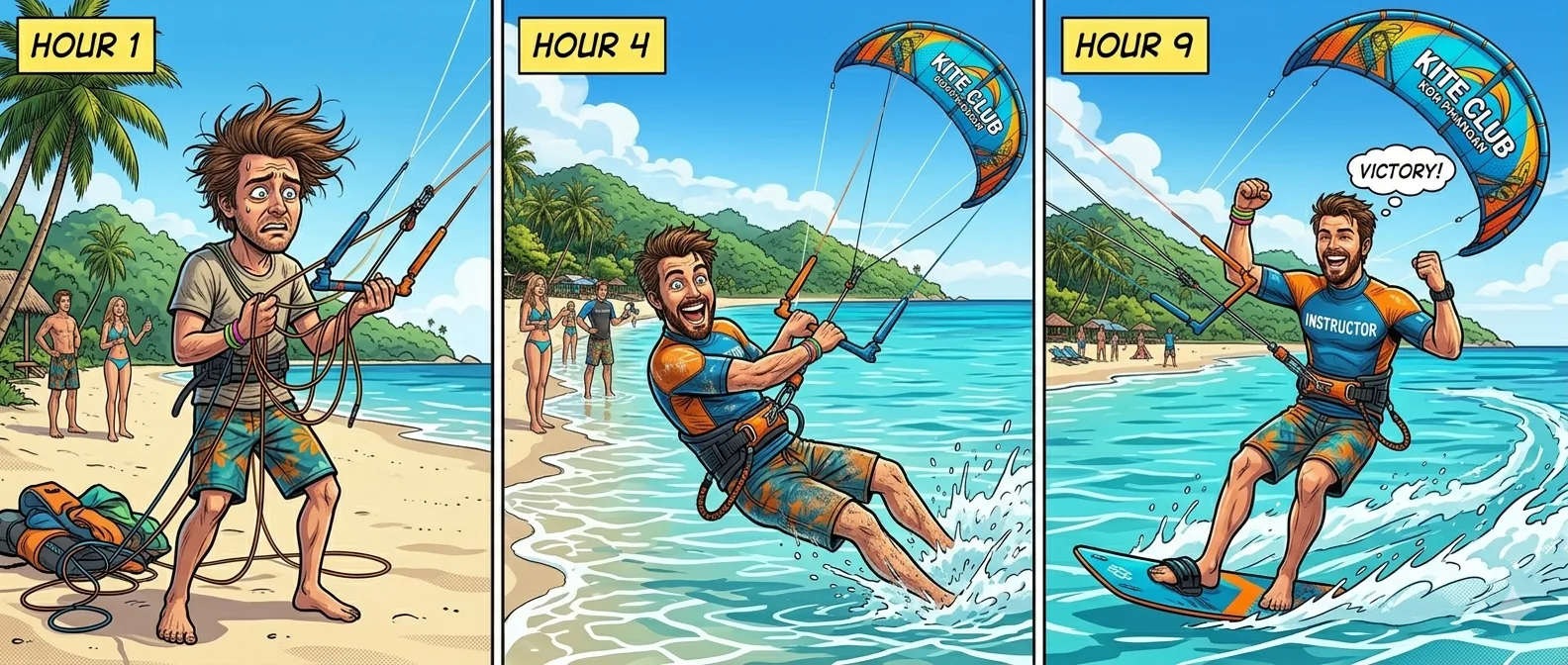
Never flown a kite? Good, that is where most of our students start. This guide walks you through choosing a month, a beach and a place to stay on Samui, what each lesson involves, and what to expect from your body and your progress.
📖 14 min read · Updated September 2026 · By Sergei Sharvarok · Founder & Head Instructor
- Before You Book: Is Kitesurfing for You?
- Choosing a Month and a Beach on Samui
- Where to Base Yourself on the Island
- The Three IKO Steps at a Glance
- How Progress Usually Unfolds
- Private or Shared Instructor?
- Gear We Supply and What to Pack
- How Your Body Will Feel
- Habits That Hold Beginners Back
- Plan B for Windless Days
- Life After Your First Course
- Beginner Questions Answered
Before You Book: Is Kitesurfing for You?
Plenty of people land at Samui airport convinced that kitesurfing is only for athletic twenty-somethings with years of surfing behind them. In reality, the sport rewards patience and calm far more than raw strength. The harness takes the pull of the kite on your hips, so your arms steer rather than haul. If you can relax in the sea and follow clear instructions, you have most of what you need.
A short honest checklist before you message us:
- Water comfort — you should be happy floating and swimming a short distance in the sea without a board or buoyancy aid. Speed does not matter; staying relaxed does.
- Injuries — tell us about any recent back, knee, shoulder or wrist problems when you book so your instructor can plan around them.
- Time on the island — the more days you have, the more likely you are to catch good wind. A week gives you a comfortable buffer; three or four days can work in peak season.
- Expectations — the first lesson is about the kite, not the board. Riding comes later, and it arrives faster when the early steps are solid.
Background in snowboarding, wakeboarding or surfing helps with board balance, but it is not required. Many of our students have never stood on a board before, and they progress through the same IKO steps as everyone else.
Send us a WhatsApp message on +66 99 312 9042 with your travel dates, where you are staying and whether you want a private or a shared lesson. We will tell you which beach is running and suggest a realistic schedule for the wind forecast that week.
Choosing a Month and a Beach on Samui
Samui is unusual because it gets usable wind from two monsoons, each blowing onto a different coast. Kite Club follows the wind: from December to April the school works on the east side at Lamai Beach, and from May to October it moves to the west side at Nathon Beach, right by Nathon town and the ferry pier. Lessons, rental, storage, e-foil, kayak and SUP all move with it.
| Period | Beach | Typical wind | What it means for a beginner |
|---|---|---|---|
| December | Lamai (east) | NE monsoon building, 12–20 kts | Season opens; the rains of late year are usually easing |
| January–March | Lamai (east) | NE monsoon, 12–20 kts | Peak months: the steadiest wind of the year and the easiest time to plan a course |
| April | Lamai (east) | NE, tailing off | Still workable; the Lamai season ends |
| May–October | Nathon (west) | SW monsoon, 10–18 kts | More variable, so build extra days into your stay |
| October–November | Varies | Light and variable (transition) | Rainy, unreliable for kiting; e-foil, SUP and kayak are better bets |
If your dates are flexible and learning is the main goal, January to March at Lamai is the safest choice. If you are coming in the middle of the year, Nathon can still work well; just avoid squeezing a whole course into two or three days.
Because the school changes coast with the season, always check which beach is active before you book a hotel far from it. Lamai and Nathon sit on opposite sides of the island, and the drive between them crosses the hills in the middle of Samui.
Where to Base Yourself on the Island
Samui is big enough that your choice of area shapes your lesson days. Most visitors fly into Samui International Airport (USM) in the north-east, and taxis reach every part of the island. Here is how the main areas work for a learner:
- Lamai — the obvious choice from December to April. You can walk or take a short ride to the beach, check the wind in the morning and be on the sand quickly.
- Chaweng — busier and livelier, a short drive north of Lamai. Good if you want nightlife and restaurants between sessions.
- Bophut and Fisherman's Village — quieter evenings and close to the airport. Expect a longer drive to either kite beach.
- Maenam — calm and relaxed on the north coast, handy for the west side in the mid-year season.
- Nathon — the practical base from May to October, with local markets, a working town feel and the ferry pier next door.
If you are splitting your holiday between Samui and a neighbouring island, the ferry from Nathon makes it simple to combine a course here with a few days elsewhere.
The Three IKO Steps at a Glance
Kite Club teaches the IKO system, so every step is recognised at IKO centres around the world. "Private" means one student with one instructor; "group" means two students sharing one instructor, which is why group lessons are longer for the same price.
| Course | Price | Private | Group (2:1) | Aim |
|---|---|---|---|---|
| Discovery | 5,000 THB | 2 h | 3 h | Understand the wind, fly the kite safely, first body drags |
| Full Beginner | 14,000 THB | 6 h (3 × 2 h) | 9 h (3 × 3 h) | Water starts and first rides, IKO Level 1–3 |
| Independent | 20,000 THB | 10 h (5 × 2 h) | 15 h (5 × 3 h) | Upwind riding, self-launch, self-rescue, IKO Level 3–4 |
You can stop after any step. Some travellers take only the Discovery lesson to see whether the sport clicks; others book the Full Beginner course from the start because they already know they want to ride. Your IKO level is recorded, so you can continue the next step on a later trip, at Samui or at another IKO school.
How Progress Usually Unfolds
Every student moves at a different speed, and the wind on the day matters as much as talent. Still, most beginners pass through the same stages in roughly this order.
Stage 1: Reading the wind on the sand
Your instructor starts on the beach with the wind window: where the kite is gentle, where it pulls hard, and why. You set up the equipment together, learn the hand signals used on the water, and practise the safety release until you can do it without thinking. Then you fly a kite yourself, first with lots of help, then with less.
Stage 2: Letting the kite pull you through the water
Before a board ever appears, you go into the sea and let the kite drag you along. This is called body dragging. It teaches you to steer with one hand, to feel how power builds in the kite, and to move yourself back towards a lost board. It looks humble, but it is the step that makes everything later feel manageable.
Stage 3: The board and the water start
Next you sit in the water with the board on your feet and use a smooth, deliberate kite movement to rise up. The first attempts usually end in a splash, which is completely normal. Your instructor adjusts one thing at a time: kite position, timing, where your weight sits on the board.
Stage 4: Short rides and turning around
Once you can stand, the work becomes keeping the kite moving while you ride, slowing down, stopping and changing direction. Early rides drift downwind; that is expected. Learning to hold ground and ride back upwind is what the Independent course is designed for.
Judge your progress by what you can repeat, not by your single best moment. One lucky ride is exciting; five water starts in a row mean you are ready for the next step.
Private or Shared Instructor?
Both formats cost the same and cover the same IKO content. The difference is how the time is used.
- Private (1:1) — every minute of feedback is yours. Sessions are shorter (2 hours), which suits people who tire quickly in the sun or want the most direct route to riding.
- Group (2:1) — you share an instructor with one other student and get longer sessions (3 hours). Watching someone else make and fix mistakes is surprisingly useful, and couples or friends often enjoy learning side by side.
If you are unsure, tell us about your fitness, confidence in the water and how many days you have. We will suggest the format that fits.
Gear We Supply and What to Pack
Lessons include all the kitesurfing equipment you need. You do not have to buy anything before your first course.
| Item | Provided? | Why it matters |
|---|---|---|
| Kites in several sizes | Yes | Your instructor matches the size to the wind and your weight |
| Bar, lines and safety system | Yes | Includes the quick release you practise on day one |
| Twin-tip board | Yes | Sized to your weight and level |
| Harness | Yes | Transfers the kite's pull to your hips instead of your arms |
| Helmet and impact vest | Yes | Worn by beginners during lessons |
What to bring from your hotel: swimwear, a long-sleeve rash vest or UV top, strong reef-friendly sunscreen, sunglasses with a strap if you wear them, a hat for breaks, plenty of water and a towel. Samui sun is intense in the middle of the day, and the reflection off the water doubles it.
How Your Body Will Feel
Kitesurfing is less about muscle than people expect, but the first days still leave a mark. Forearms work hard because beginners grip the bar too tightly. Thighs and core feel the board stance. Your lower back may notice the harness if you lean on it in an unusual way. None of this is a reason to stop; it fades as your technique relaxes.
- Hydrate — drink before, during breaks and after each lesson. Heat and salt water dehydrate you faster than you notice.
- Sleep — new movement patterns settle overnight. A late night in Chaweng usually shows up in the next morning's lesson.
- Stretch — a few minutes for the hips, back and forearms after a session helps you arrive fresh for the next one.
- Pace yourself — our lessons are deliberately 2 or 3 hours long. Shorter, focused blocks beat long, exhausted ones.
Nervousness is normal too. The kite is powerful, and respecting it is healthy. The practical cure is repetition of the safety systems: once you trust the release and know exactly what to do when something feels wrong, the fear usually turns into focus.
Habits That Hold Beginners Back
- Hurrying to the board — skipping solid kite control makes every water start harder.
- Staring at your feet — keep your eyes on the kite until you are up and moving.
- Pulling in with bent arms — let the harness carry the load and keep your arms long.
- Moving the kite timidly — a hesitant kite gives weak, uneven pull; a smooth, committed movement lifts you.
- Letting go when overpowered — pushing the bar away to depower is the right reaction; releasing it completely is often not.
- Riding with a flat board — tilt the edge against the pull or the board will slide away.
- Comparing yourself to others — the student next to you may have a snowboarding background or a lighter week of wind.
Plan B for Windless Days
Wind is a natural resource, not a timetable. On a calm day your lesson is simply moved to the next good window, which is another reason to arrive with spare days. Meanwhile the beach still has plenty to do:
- E-foil — an electric hydrofoil board that needs no wind. The 30-minute intro is 2,000 THB, and the board-balance feeling carries over nicely to kitesurfing later.
- SUP — 400 THB for an hour, 700 THB for two or 1,000 THB for the whole day.
- Kayak — 500 THB for an hour, 900 THB for two or 1,200 THB for three hours.
Windless mornings are also a good time to explore the island: the viewpoints above Lamai, the walking streets of Fisherman's Village or the markets in Nathon.
Life After Your First Course
Finishing the Full Beginner course usually means you can water start and ride short distances with supervision. The Independent course then builds the skills that let you ride without an instructor: going upwind, launching and landing on your own, recovering the kite in the water and judging conditions.
- Your IKO card — it records your level, so any IKO centre can see where you are and continue from there.
- Coming back — skills return quickly after a break. Many students plan a second trip around the Lamai peak months to finish their progression.
- Sister school — if you also visit the neighbouring island, Kite Club Koh Phangan teaches the same IKO courses.
- Storage and rental — once you ride independently, you can rent gear or store your own kit with us between sessions.
Before you leave, ask your instructor for two or three specific things to work on next time. A short written list saves your first session of the next trip.
Beginner Questions Answered
Yes. Board experience speeds up balance, but the course starts with kite control on the beach and builds up step by step. Complete beginners follow the same IKO path as everyone else.
January to March at Lamai Beach usually brings the steadiest north-east wind of the year, 12–20 knots. December and April are also good. From May to October the school runs at Nathon Beach, where the wind is more variable.
The Full Beginner course is three lessons: 3 × 2 hours private or 3 × 3 hours in a group. Plan a few extra days on the island so a calm day does not squeeze your schedule.
Both cost the same. Private lessons are 1:1 and shorter, with every minute of feedback for you. Group lessons are 2 students per instructor and last longer. Couples and friends often prefer the group format.
Your lesson moves to the next suitable wind window. You do not lose it. In the meantime you can try the e-foil, which needs no wind, or rent a SUP or kayak.
From December to April, Lamai is the most convenient base, with Chaweng a short drive away. From May to October the school is at Nathon on the west coast, so Nathon or the north coast around Maenam works better.
Planning a Samui Kite Trip Around Your Course
Think of the course as the backbone of the trip and plan the rest around it. Pick your season first: Lamai from December to April, with the most dependable wind from January to March, or Nathon from May to October if your holiday falls mid-year. Then choose accommodation near the active beach, so a good wind forecast never turns into a long taxi ride. Book the Discovery lesson early in your stay; if it clicks, you can continue straight into the Full Beginner course, and later into the Independent course if you want to ride on your own. Keep a couple of free days as a buffer, fill calm days with the e-foil, a SUP or a kayak, and leave the island tours for mornings when the sea is flat. With that plan in place, most first-timers leave Samui with an IKO level on record and a clear idea of what to practise next.
Questions about your dates or level? Message Kite Club Koh Samui on WhatsApp at +66 99 312 9042. Our instructors teach in English, Russian, Arabic, German and Ukrainian, at Lamai Beach from December to April and at Nathon Beach from May to October.