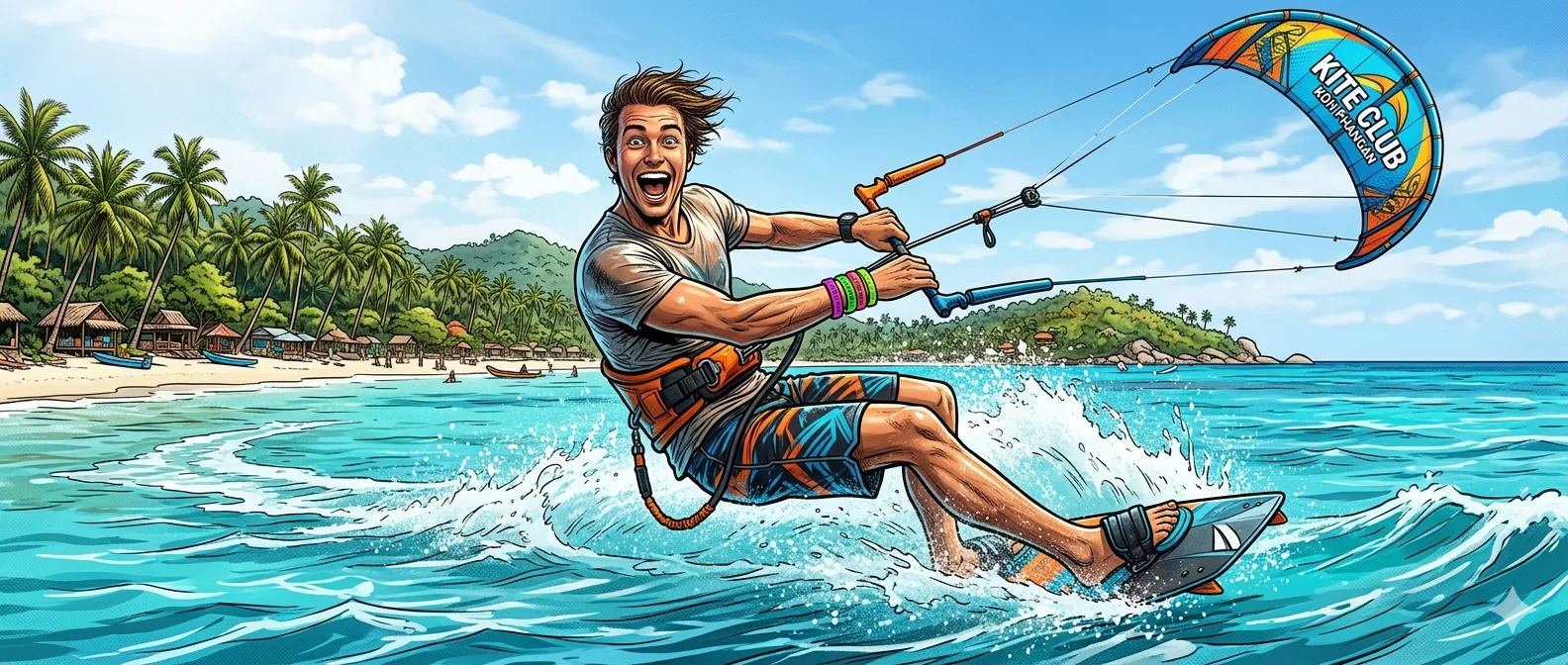
One long page for people who are actually booking: which beach we use in which month, how the courses are structured, how to get from the airport to the sand, where to sleep, and what to do when the breeze takes a day off.
📖 18 min read · Updated May 2026 · By Sergei Sharvarok · Founder & Head Instructor
- Start Here: Pick Your Month First
- Two Monsoons, Two Coasts
- Lamai Beach, December to April
- Nathon Beach, May to October
- Choosing the Right Course
- How a Lesson Day Unfolds
- Gear: Included vs. Pack Yourself
- Wing Foil, Windsurf, E-Foil and Paddling
- Arriving on Samui
- Where to Sleep in Each Season
- Putting a Budget Together
- Light-Wind Days: Plan B
- How Sessions Are Kept Safe
- Your IKO Card and What It Unlocks
- Habits That Speed Up Learning
Start Here: Pick Your Month First
Koh Samui is really two kite destinations sharing one island. The east coast gets the wind from roughly December to April, the west coast from roughly May to October, and the whole school — lessons, rental, storage, e-foil, kayaks and SUPs — packs up and moves between them. So the first question is never "is Samui good for kiting?" but "when am I coming, and which beach will that put me on?"
A quick rule of thumb: if your dates are flexible and you are a beginner, aim for January, February or March. If you are coming in the European summer, you will ride at Nathon and should keep a couple of days spare. If your only free weeks are in October or November, plan a general island holiday and treat kiting as a bonus.
Tell us your travel dates on WhatsApp before you book flights. We will tell you honestly which spot you will be at and what the wind usually does in that window.
Two Monsoons, Two Coasts
Samui sits in the Gulf of Thailand, off the coast of Surat Thani province, with Koh Phangan a short hop to the north. The island has a hilly, forested middle, and that high ground matters: when the wind comes from the northeast, the east coast is exposed and the west coast is sheltered, and when it swings to the southwest, the situation reverses.
This is why a school that stays on one beach all year would spend half the year waiting. We follow the monsoon instead. The table below is the simplest way to see how the year breaks down.
| Months | Where we teach | Wind pattern | Our honest take |
|---|---|---|---|
| December | Lamai (east) | NE monsoon arriving | Good when the wind is in; rain still possible early in the month |
| January–March | Lamai (east) | NE, typically 12–20 kts | The most reliable period of the year — first choice for a course |
| April | Lamai (east) | Easing, turning more easterly | Still rideable, lighter days more common |
| May–October | Nathon (west) | SW, typically 10–18 kts | Rideable season, more variable; afternoons usually best |
| October–November | Depends on conditions | Transition, light and changeable | Rainy period; e-foil, kayak and SUP carry the programme |
Samui's wet season runs roughly October to December, which is the reverse of Bangkok and the Andaman coast. Many travellers are surprised by sunny, windy weeks on Samui in February when they expected "rainy season" advice from other parts of Thailand.
Lamai Beach, December to April
Lamai is a long sandy bay on the east coast, about 30 minutes by car from Samui Airport and a short drive south of Chaweng. The rock formations known as Hin Ta and Hin Yai mark its southern end, and Lamai village runs along the back of the beach with guesthouses, restaurants and cafés for every budget.
In the northeast monsoon the wind blows in from the sea, which is what you want as a learner: if something goes wrong, the wind pushes you back towards the beach rather than away from it. Instructors pick the exact teaching area on the day, adjusting for the wind angle, any swell, and where swimmers are.
Who Lamai suits
Complete beginners, people taking the Full Beginner or Independent course, and riders who want a steady moderate breeze to practise transitions and upwind riding. If your group includes non-kiters, Lamai is also a comfortable base with plenty to do on foot.
Nathon Beach, May to October
Nathon is Samui's administrative town on the west coast, and the beach we use sits right beside the town and the main ferry pier where boats from Donsak on the mainland arrive. It is about 40 minutes by car from the airport and 30–40 minutes from Lamai.
The southwest monsoon typically gives 10–18 knots here. It is more changeable than the winter season at Lamai, and the afternoon is usually the better part of the day, so lessons are often scheduled later. The upside: fewer tourists, local markets, a proper Thai town atmosphere, and sunsets over the sea.
Who Nathon suits
Travellers on a summer holiday, lighter riders who enjoy moderate wind, wing foilers, and beginners who can stay flexible about which days they ride.
| Lamai | Nathon | |
|---|---|---|
| Coast | East | West |
| Season | December–April | May–October |
| Typical wind | 12–20 kts (NE) | 10–18 kts (SW), more variable |
| Best window | January–March | Afternoons |
| Drive from USM airport | ~30 min | ~40 min |
| Feel | Beach village, busy in high season | Local town, ferry pier, quieter |
Choosing the Right Course
All kitesurfing courses follow the IKO system. "Private" means one student with one instructor; "group" means two students sharing an instructor. Group sessions run longer to give each person similar time with the kite.
| Course | Price | Private | Group (2:1) | Good for |
|---|---|---|---|---|
| Discovery | 5,000 THB | 2 h | 3 h | Trying kiting before committing |
| Full Beginner | 14,000 THB | 6 h (3 × 2 h) | 9 h (3 × 3 h) | Going from zero to first rides |
| Independent | 20,000 THB | 10 h (5 × 2 h) | 15 h (5 × 3 h) | Reaching the point of riding and renting on your own |
Splitting hours into separate sessions is deliberate. Your arms and your brain both need a break, and it lets us put each session into the best wind of that day. On a one-week holiday, the Full Beginner course fits comfortably with spare days in reserve; the Independent course is better with ten days or more.
If you have surfed, snowboarded or wakeboarded, you will probably find the board part easier — but kite control is new for everyone. Do not skip the land and body-drag stages because the board feels familiar.
How a Lesson Day Unfolds
Every session starts on the sand. Your instructor looks at the wind and the sea, chooses a kite size to suit the conditions and your weight, and explains the plan for the day. Then:
- Safety systems first. You learn how the quick release works and practise using it before the kite ever gets much power.
- Kite control on land. The wind window, where the power is, and how to steer smoothly and keep the kite parked overhead.
- Into the water without a board. Body dragging teaches you to steer with one hand and to move back upwind — the skill you use to get your board back after a fall.
- Board and water starts. Once kite control is reliable, the board comes out and you start learning to get up and ride.
Lessons are on a radio-helmet system where available, so your instructor can talk you through corrections while you are in the water. Progress speed depends on the wind you get and on you; nobody can promise a set number of hours to standing up.
Gear: Included vs. Pack Yourself
Kites, bars and lines, boards, harnesses and safety equipment are all provided in lessons, and the instructor chooses sizes for you. You do not need to fly with any kit. Once you can ride on your own, rental is available at the current season's beach.
Worth bringing from home:
- Sun protection. A long-sleeve rash vest or lycra, a cap you can tie on, and reef-friendly high-SPF sunscreen. Tropical sun on the water is fierce.
- Your own harness if you already have one that fits well — comfort matters over several sessions.
- Sunglasses with a strap for watching from the beach and for later sessions.
- A reusable water bottle and electrolytes. You will sweat more than you think.
The water is around 27–30 °C all year, so wetsuits stay at home. A thin top is still useful for sun and for the occasional jellyfish.
Wing Foil, Windsurf, E-Foil and Paddling
Kitesurfing is only part of what runs from the beach. Several people in a group often end up doing different things side by side:
| Activity | Starting option | Price | Needs wind? |
|---|---|---|---|
| Wing foil | Intro lesson, 2 h | 4,000 THB | Yes |
| Windsurfing | Discovery, 2 h private | 4,000 THB | Yes, lighter wind is fine |
| E-foil | Intro, 30 min | 2,000 THB | No |
| Kayak | Rental from 1 h | 500 THB | No |
| SUP | Rental from 1 h | 400 THB | Calm days are best |
Wing foil courses are taught to IWO standards, windsurfing to IKO standards. The e-foil is the obvious choice on still mornings; it gives you the feeling of flying on a foil without any wind at all and is a good introduction before trying the wing.
Arriving on Samui
Flying into USM
Samui International Airport (USM) is on the north-east tip of the island. Flights from Bangkok take roughly an hour, and some regional hubs such as Singapore and Hong Kong connect directly. From arrivals, it is about 30 minutes to Lamai and 40 minutes to Nathon.
Coming overland through Surat Thani
The cheaper option is to fly, bus or take the train to Surat Thani, then use a combined bus-and-ferry ticket from Donsak pier. The crossing takes about 1–1.5 hours and lands at Nathon — ideal between May and October, when that is where the school is.
Arriving from Koh Phangan or Koh Tao
Speedboats and catamarans link the islands every day. Koh Phangan, home of our sister school Kite Club Koh Phangan, is around 30 minutes away.
On the island, taxis, songthaews (shared pick-ups), Grab/Bolt and scooter rental all work. If you have never ridden a scooter, Samui's hilly roads are not the place to learn — pick accommodation you can walk from.
Where to Sleep in Each Season
| Area | Best in | What it is like |
|---|---|---|
| Lamai | Dec–Apr | Walk to the kite beach; relaxed village with every budget covered |
| Chaweng | Dec–Apr | Busiest part of the island, big hotel choice and nightlife, short drive to Lamai |
| Nathon | May–Oct | Local town by the pier and the kite beach; markets and sunsets |
| Lipa Noi and the west coast | May–Oct | Quiet beaches, a short ride to Nathon |
| Bophut / Maenam | Either | North coast, Fisherman's Village, close to the airport; drive to the spot |
The single biggest improvement you can make to a kite holiday is sleeping near the beach you ride. When the wind fills in an hour earlier than forecast, you want to be five minutes away, not stuck behind a songthaew on the ring road.
Putting a Budget Together
Your budget has three parts: getting here, living here, and the lessons. Flights vary hugely by season and origin, so we will not guess them for you. Living costs depend on your style — Samui has everything from simple fan rooms to five-star resorts, and eating at local Thai restaurants and night markets is far cheaper than beach-club dining.
Lesson costs are fixed and easy to plan: 5,000 THB for a Discovery session, 14,000 THB for the Full Beginner course and 20,000 THB for the Independent course. Equipment is included. If you want to keep riding afterwards, add rental days, or use our storage if you bring your own kit for a long stay.
Light-Wind Days: Plan B
Even in the best months there are days when the breeze stays below what a lesson needs. We move your session rather than cancel it, and the gap is easy to fill:
- E-foil — no wind required, and a good taste of foiling.
- Kayak or SUP from the same beach; flat days are the best days for paddling.
- Ang Thong National Marine Park — a full-day boat trip with viewpoints, snorkelling and kayaking.
- Inland Samui — Na Muang waterfalls, the Big Buddha and Wat Plai Laem.
- Fisherman's Village, Bophut — especially on its Friday walking-street evening.
- Rest. Your forearms will thank you after two days of body dragging.
How Sessions Are Kept Safe
Kitesurfing is a power sport, and a good school is mostly defined by how it manages that power. On Samui our approach is straightforward:
- Conditions are checked before every session; if the wind is too strong, too gusty or blowing offshore for your level, the lesson moves.
- The teaching area is chosen each day away from swimmers, boats and obstacles.
- You practise the safety release until it is automatic, before you ride.
- Helmets and impact vests are part of the lesson kit.
- Beginner sessions are private or at most two students per instructor.
Your job in the water is simple: if you feel out of control, let go of the bar and use the release exactly as you practised. Fighting a kite never ends well.
Your IKO Card and What It Unlocks
IKO certification records the level you reach, not the hours you paid for. The card is recognised by IKO centres around the world, so if you learn on Samui and later travel to another kite destination, the school there can see what you are able to do and what gear you can rent.
Roughly: the early levels cover safety, kite control and body dragging; the middle levels cover water starts and riding; being able to ride upwind and stay in your area is what most rental centres want to see before handing over equipment. The Independent course is designed to get you to that point.
Habits That Speed Up Learning
- Look at the kite, not your feet. Most failed water starts come from the kite drifting while the rider stares at the board.
- Eat light before a session. A big lunch and a harness are not friends.
- Hydrate the day before, not just on the day. Heat and sun catch people out in their first week.
- Ask for video. A friend on the beach with a phone can show you what the instructor keeps saying.
- Stay patient on day two. Body dragging feels slow. It is the stage that makes everything after it faster.
If you are staying for several weeks, space out your course hours and add supervised practice between them. Consolidating each step pays off more than cramming.
Frequently Asked Questions
January, February and March at Lamai Beach are the most reliable, with the northeast monsoon typically giving 12–20 knots. December and April are also good. From May to October we teach at Nathon Beach on the west coast, where 10–18 knots is typical but more variable.
It moves with the wind: Lamai Beach on the east coast from December to April, and Nathon Beach, next to Nathon town and ferry pier, from May to October.
The Full Beginner course (14,000 THB) is 6 hours private, split into three 2-hour sessions, or 9 hours in a group of two, split into three 3-hour sessions.
By taxi, transfer or Grab/Bolt. Lamai is about 30 minutes from Samui International Airport (USM) and Nathon about 40 minutes.
Yes. Kite, bar, board, harness and safety gear are provided. Bring sun protection; your own harness is optional.
Your lesson is moved to a better day. In the meantime you can try e-foil, which needs no wind, rent a kayak or SUP, or explore the island.
Book Your Koh Samui Kite Course
IKO-certified lessons at Lamai Beach (Dec–Apr) and Nathon Beach (May–Oct).
Book Now →