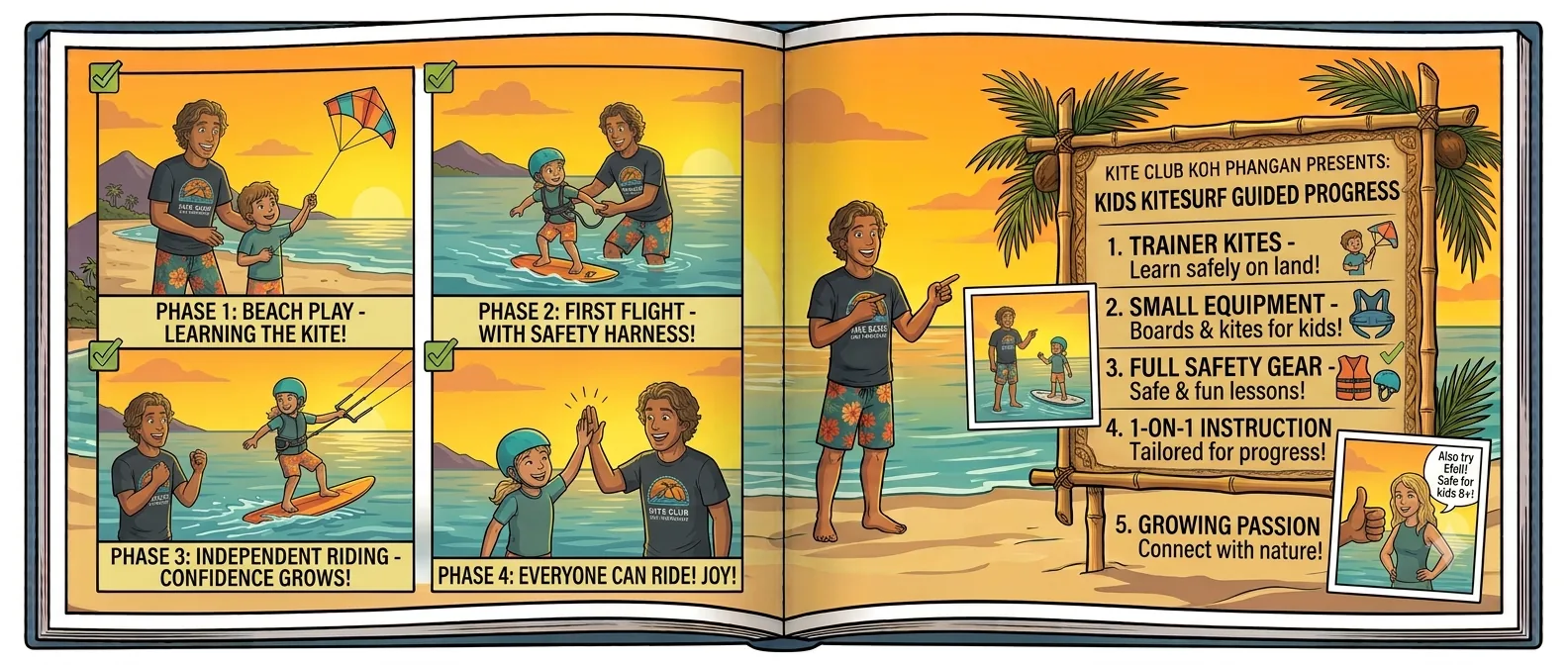
Thinking about kite lessons for your son or daughter while the family is on Samui? This guide answers the questions parents actually ask us — how young is too young, why body weight matters more than a birthday, what a junior lesson looks like, and what the rest of the family can do in the meantime.
Contents
Is My Child Ready? Weight Before Age
Parents usually open with “what’s the minimum age?”. The honest answer is that we do not have a strict one. Children from around 8 years old can start, but the number that really decides it is body weight: roughly 30–35 kg at the minimum.
The reason is physics rather than policy. A kite pulls on the rider through the harness, and a very light child simply has less mass to anchor that pull, especially in a gust. Above that weight range we can choose a small kite and a calm day and the child stays in control; below it, even the smallest equipment can feel too strong. Two children of the same age can therefore get two different answers.
Beyond the scale, we look for three things:
- Comfort in the sea. They do not need to be strong swimmers, but they should be happy with their face in the water and with being tumbled around a little.
- Ability to listen for a while. Kite control is taught step by step, and each step builds on the last.
- Their own motivation. Kids who want to be there progress quickly. Kids who were signed up because a parent wanted it usually tell us within twenty minutes.
If you are unsure, send us your child’s age and weight on WhatsApp and we will give you a straight answer before you book anything.
What Happens in a Junior Lesson
Children follow the same IKO programme as adults — there is no watered-down “kids’ certificate”. What changes is the pacing and the amount of time spent on each stage.
On the sand
Every student starts on land with a small trainer kite. This is where children learn the wind window, how steering works and — most importantly — how to let go. We practise the safety release until it is automatic, because in the water there is no time to think about it.
In the water without a board
Next comes body dragging: being pulled through the water by the kite while steering it. Kids tend to love this stage. It teaches them how to control power and how to get back to a lost board, and it is where most of them start laughing instead of concentrating.
Board starts
Only when kite control is solid do we add the board. Waterstarts take patience at any age, and for lighter riders the kite size and the day’s wind need to be spot on. We would rather wait for the right conditions than push a child into a session that is too powerful for them.
Throughout all of this, your child wears a radio helmet. The instructor talks to them in real time — “bar out a little”, “kite up to twelve o’clock” — which is especially helpful for young riders who cannot always hear shouted instructions over wind and waves.
Which Course Makes Sense for a Child
| Option | Price | Time on the water | Good for |
|---|---|---|---|
| Discovery | 5,000 THB | 2 h private or 3 h group | A first taste — finding out whether they actually like it |
| Full Beginner | 14,000 THB | 6 h private (3 × 2 h) or 9 h group (3 × 3 h) | Kids who are keen and want to reach their first rides |
| Independent | 20,000 THB | 10 h private (5 × 2 h) or 15 h group (5 × 3 h) | Teenagers aiming to ride on their own later |
For younger children we usually recommend private lessons. One instructor with one student means full attention, and a two-hour block is about right for a child’s energy and focus. Group lessons (two students per instructor) work well for siblings or two friends of similar weight who want to learn together.
Starting with the Discovery lesson is the lowest-risk way in. If your child loves it, the next step is easy to add; if not, you have found out without committing to a full course.
How We Keep Young Riders Safe
Kitesurfing has a risky reputation, mostly from videos of people jumping. A beginner lesson looks nothing like that. For junior students we keep the margins wide:
- Small kites and conservative sizing — we would rather they are slightly underpowered than overpowered.
- Lessons only in wind that suits their weight; on stronger days we reschedule rather than “try anyway”.
- Constant instructor supervision and radio-helmet contact, plus team support on the beach.
- Helmet and impact vest on every water session, and a quick-release system they have practised many times on land.
- A parent or guardian on the beach for younger students, so someone who knows the child is always close by.
Our lessons are run by Sergei, the founder and head instructor, and Abdulla — both IKO Level 3 instructors. Both adjust the lesson to the student in front of them, not to a timetable.
When the Family Should Visit
Samui has two kite seasons. From December to April we teach at Lamai Beach on the east coast, where the north-east monsoon usually gives 12–20 knots; January to March is the most consistent stretch. From May to October we are at Nathon Beach on the west coast, where the south-west wind is lighter (around 10–18 knots) and more variable.
For lighter children, the lighter days are often a good thing — the kite is easier to hold, and we can use them for the first stages of the course. For heavier teenagers, the steady Lamai wind in January to March is ideal. Many families come over Christmas or during the European spring holidays, which both fall in the Lamai season.
October and November are the months to be careful with. They are a transition between the monsoons, the wind is light and unreliable, and the rainy season (roughly October to December) brings more showers. If your only family holiday falls then, plan kitesurfing as a bonus rather than the main event, and keep a few flexible days in the schedule so we can use any windy spell that comes along. Kayaks and SUP boards run in calm weather, so the kids will not be stuck on the sand either way.
Frequently Asked Questions
Book a Lesson for Your Child
Kite Club Koh Samui · Lamai Beach (Dec–Apr) · Nathon Beach (May–Oct) · Tell us age and weight on WhatsApp
Book via WhatsAppA Typical Family Kite Week on Samui
Here is how a week often looks for families who base themselves in Lamai during the east-coast season. The first morning is the Discovery lesson — two hours of trainer kite and first steps in the water while a parent watches from the sand. If it clicks, the Full Beginner course is split over the following days, usually with a rest day in the middle. That rest day matters more than people think: children tire quickly in the sun, and a fresh kid learns faster than a tired one.
Non-kiting family members are rarely bored. Lamai village has cafés and restaurants a few steps from the beach, Chaweng is a short drive for shopping, and Fisherman’s Village in Bophut is a relaxed evening out. Younger siblings can paddle a kayak or a SUP close to shore while the older one is in a lesson.
Families visiting between May and October follow the same idea at Nathon, on the quieter west coast. Nathon town has everything you need for a lunch break, and the sunsets over the water are a good reward at the end of a lesson day. Because the wind there is more variable, we plan lessons day by day from the forecast and let you know the time the evening before.
Worries Parents Often Mention
“What if the kite pulls my child away?” This is the most common fear, and the answer is built into the equipment. Every kite bar has a quick-release that dumps the kite’s power in a second. Children practise it on the sand again and again until they do it without thinking, and in the water the instructor is close enough to step in. We also choose kite sizes on the small side for junior riders, so the pull is manageable to begin with.
“My child is not a strong swimmer.” That does not rule them out. Every student wears an impact vest that adds buoyancy, and the early stages of the course happen where the instructor can reach them quickly. What we do need is a child who is relaxed in the sea — if they panic when a wave splashes their face, a few days of playing in the water or on a paddleboard first will help more than any lesson.
“Will they be bored by the theory?” Less than you might expect. The land part is hands-on: flying a trainer kite, drawing the wind window in the sand, practising the release. Instructors keep the talking short and let children feel the kite as soon as possible.
“How much will they actually learn in a week?” That depends on the child, the wind and how many lesson days fit into your trip. Some children stand up on the board during the Beginner course; others spend longer on kite control and body dragging. Both are real progress, and the instructor will tell you honestly where your child is after each session.
How Parents Can Help
The biggest thing you can do is keep it fun. Children notice when adults are anxious, and a nervous child holds the bar tighter and learns more slowly. Watch, cheer, take photos — and leave the coaching to the instructor, who is already talking to your child through the radio helmet.
- Put on sunscreen and a long-sleeved rash vest before every session; midday sun on the water is intense.
- Bring plenty of water and a snack for afterwards — kiting burns energy fast.
- Keep lesson days light otherwise; a long excursion the same morning is a recipe for a tired, grumpy student.
- Ask the instructor after each session what went well and what is next, so you can talk about it at dinner.
After the Course
Children who finish the Independent course and reach the level where they can ride and go upwind on their own have a certification recognised at IKO schools around the world. For travelling families that is a real bonus: the same card lets them continue on future holidays. Teenagers who get hooked sometimes come back the following season to rent equipment and keep riding under our supervision, or join a Kite Club safari with a parent once they are confident riders.
If your child is not ready for kiting yet, that is fine too. Time on a paddleboard or kayak builds comfort in the sea, and a year of growing can make all the difference on the scale. We are happy to look again on your next visit.