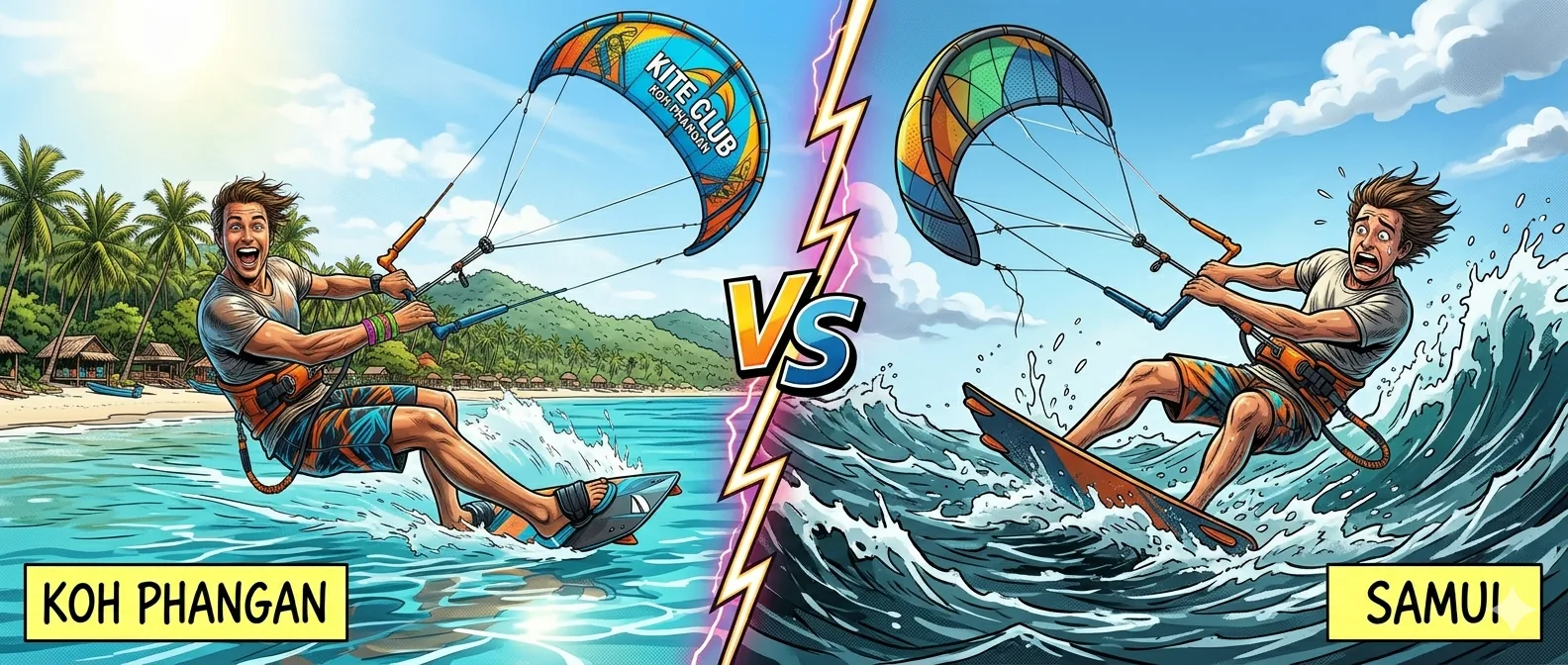
Four popular places to kite in Asia, four very different trips. Instead of crowning a winner, this guide helps you match a destination to your dates, your level and the kind of holiday you want around the riding — with an honest look at where Koh Samui fits.
Contents
Start With Your Calendar
The most useful question is not “which place is best?” but “which place has wind when I can travel?”. Each destination depends on a monsoon, and those monsoons peak at different times of the year. Get this wrong and even the most beautiful beach is a very expensive sunbathing trip.
| Destination | Main kite season | Character of the wind |
|---|---|---|
| Koh Samui, Thailand | Dec–Apr at Lamai (east coast) · May–Oct at Nathon (west coast) | Lamai: NE monsoon, 12–20 kts, steadiest Jan–Mar · Nathon: SW monsoon, 10–18 kts, more variable |
| Bali, Indonesia | Roughly June to September | South-east trade wind; spots on the south-east coast |
| Sri Lanka (Kalpitiya) | Roughly May to October, with a shorter second season around the turn of the year | Often strong, especially mid-season |
| Vietnam (Mui Ne) | Roughly November to April | Strong, consistent north-east wind; powerful days are common |
Samui has one feature the others do not: because Kite Club moves between two coasts, there is a teaching spot open in both halves of the year. The main gap is October–November, when the wind switches direction and is light and unreliable. Mui Ne and Lamai are strongest at roughly the same time, so a winter trip is a genuine either/or; a summer trip puts Samui’s Nathon season up against Bali and Sri Lanka.
Rain is the other half of the calendar. On Samui the wettest stretch is roughly October to December, which overlaps with the light-wind transition and the start of the Lamai season. By January the weather has usually settled, and the combination of dry days and steady wind makes January to March the most reliable window of the year. If you are planning around Christmas or New Year, it is still very much worth coming — just expect a few showers and keep a flexible day or two.
Wind Strength: More Is Not Better for Beginners
Experienced riders tend to chase the windiest spots. Beginners should do the opposite. Your first sessions are about learning to control power, and it is much easier to do that on a moderate day with a medium-sized kite than on a day when every gust tries to pull you downwind.
That is where the destinations separate. Mui Ne and Kalpitiya are known for their power — great once you can ride, demanding when you cannot. Samui’s Lamai season sits in a comfortable learning range, and Nathon’s lighter wind suits the early stages of a course and lighter riders, although it also means more waiting on quiet days. Bali’s season can be very good, but conditions differ a lot from spot to spot.
What the Water Is Like
Samui lies in the Gulf of Thailand, sheltered from the big ocean swells that reach Bali and the Sri Lankan coast. On windy days you get chop rather than surf. The water is warm year-round, so you ride in boardshorts or a rash vest, not a wetsuit.
Bali’s kite spots are exposed to the Indian Ocean and influenced by reef and tides, which suits confident riders more than first-timers. Kalpitiya is famous for its flat-water areas as well as ocean riding, making it popular for freestyle progression. Mui Ne combines strong wind with waves that build through the season — exciting, but a lot for someone on day one.
Getting There and Getting Around
| Koh Samui | Bali | Sri Lanka | Vietnam | |
|---|---|---|---|---|
| Nearest airport | Samui International (USM), on the island | Denpasar (DPS) | Colombo (CMB), then a long drive north | Ho Chi Minh City (SGN), then a drive east |
| Alternative route | Fly to Surat Thani, ferry from Donsak to Nathon | Many international connections | Road only | Road or train |
| Time from airport to kite spot | Short drive to Lamai or Nathon | Short drive to the south-east coast | Several hours | Several hours |
For short trips, this matters more than people think. On Samui you can land in the morning and be on the beach for a lesson the same afternoon. With a long transfer at each end, a one-week trip can lose a whole day of riding.
Teaching Standards and Language
You will find IKO-certified schools in all four places, and quality varies inside every destination — the country matters less than the school you choose. Ask any school the same questions: are instructors certified, how many students per instructor, how do they communicate with you on the water, and what happens on days with too much or too little wind?
At Kite Club Koh Samui, lessons are private (1:1) or small-group (2 students per instructor), coaching in the water is done through radio helmets, and our instructors Sergei and Abdulla are both IKO Level 3. Lessons are available in English, Russian, Arabic, German and Ukrainian — useful if you learn better in your own language.
What a Beginner Course Costs on Samui
| Course | Price | Duration |
|---|---|---|
| Discovery | 5,000 THB | 2 h private or 3 h group |
| Full Beginner | 14,000 THB | 6 h private or 9 h group |
| Independent | 20,000 THB | 10 h private or 15 h group |
All equipment is included. We do not publish prices for other destinations here because they change often and differ widely between schools; compare what is included (gear, hours on the water, group size) rather than headline prices alone. Accommodation on Samui ranges from simple guesthouses to high-end resorts, so the overall budget depends far more on where you sleep than on where you kite.
Life Off the Water
Bali has the widest choice of everything — food, culture, surf, nightlife — and the crowds and traffic that come with it. Kalpitiya is quieter and more remote, loved by riders who want to kite, eat and sleep. Mui Ne is a resort strip built largely around wind sports.
Samui sits somewhere in the middle. Lamai has a village atmosphere with restaurants a few steps from the sand; Chaweng offers nightlife; Fisherman’s Village in Bophut and the quieter beaches of Maenam suit slower evenings. On no-wind days you can visit Ang Thong Marine Park, take a SUP or kayak out, or try the e-foil, which does not need wind at all.
Which One Fits You?
- Choose Koh Samui if you are learning from scratch, want a short journey from the airport to the beach, and like having a comfortable holiday island around your lessons — in either half of the year.
- Choose Bali if you already ride, travel in the southern-hemisphere winter, and want surf and culture as much as kiting.
- Choose Sri Lanka if you want stronger wind and flat water for progression, and do not mind a remote base.
- Choose Vietnam if you are an intermediate or advanced rider looking for power during the northern winter.
Frequently Asked Questions
Learn to Kite on Koh Samui
IKO-certified instruction · Lamai Dec–Apr · Nathon May–Oct · Discovery from 5,000 THB
Book via WhatsAppCombining Destinations in One Trip
Because the seasons interlock, some riders build a longer trip across two places. A common idea is to learn on Samui during the Lamai season and, once you ride independently, move on to a windier spot to put the new skills under pressure. Bangkok is the natural hub: flights to Samui, Denpasar, Colombo and Ho Chi Minh City all connect through it or through other nearby hubs.
If you have three or four weeks, a sensible sequence is: course first, somewhere with moderate wind; practice second, somewhere with more power. Doing it the other way round often means spending expensive days on the beach watching the wind be too strong for you. Samui also works well at the start of a Thailand trip — land at USM, do your course, then continue to the rest of the country.
Planning tip
Build a couple of spare days into any kite trip, wherever you go. Wind forecasts are good but not perfect, and having flexibility means a quiet day costs you nothing instead of a lesson.
A Checklist Before You Book Anywhere
Whichever country you pick, the school makes more difference to your first week than the destination. These questions work everywhere:
- How many students per instructor? One or two is ideal for beginners. Larger groups mean more waiting on the sand.
- How do instructors talk to you in the water? Radio helmets, a boat, or shouting from the beach are very different experiences.
- What is included? Kite, board, harness, helmet and vest should all be part of the price.
- How are hours counted? Ask whether time spent on the beach counts toward your lesson, and what happens if the wind drops mid-session.
- What if there is no wind on your lesson day? A good school reschedules rather than running a lesson in unsuitable conditions.
- Which certification do you get? IKO is the most widely recognised for kitesurfing.
Ask these in a message before you book and pay attention to how quickly and clearly the answers come back. It tells you a lot about how the school runs day to day.
Samui in Summer: The Nathon Option
Many European holidays fall in July and August, which is not Samui’s peak kite season. It is, however, not dead either. From May to October Kite Club teaches at Nathon Beach on the west coast, next to Nathon town and the ferry pier, in the south-west monsoon. The wind is typically 10–18 knots and less predictable than Lamai’s winter breeze, so we plan lessons day by day from the forecast.
For some students this actually works well: lighter days are good for kite control and the first stages of a course, and the west coast is quieter than the big resort beaches. Riders who want guaranteed strong wind in summer will probably be happier in Sri Lanka or elsewhere; families and first-timers who want a relaxed island holiday with lessons thrown in often find Nathon a good fit.
And If You Already Ride
Certified riders can rent full kite sets on Samui — 2,000 THB for 1 hour, 3,500 THB for 2 hours, 4,500 THB for 3 hours or 5,000 THB for a full day — or book a 2-hour Refresh session (3,500 THB) to get back into it. Intermediate riders who want a pure kite week with other riders might also look at the Kite Club safari on the Red Sea in Egypt, which runs in April–May and September–November.