Contents
Start With the Wind, Not the Website
Photos of turquoise water look the same on every school's website. What really decides how your lessons go on Samui is whether the school is teaching in the right place for the month you visit. The island gets its kiting wind from two monsoons that blow onto opposite coasts: the north-east monsoon reaches the east side from December to April, and the south-west monsoon reaches the west side from May to October.
That is why Kite Club moves: Lamai Beach on the east coast from December to April, with the steadiest wind in January–March, and Nathon Beach on the west coast, next to the town and ferry pier, from May to October. Whichever school you consider, ask where they teach during your dates and why. A clear, specific answer tells you they plan around the conditions rather than around a fixed address.
October and November are a transition period with light, variable wind and the rainy season. A school that honestly tells you those months are better for e-foil, SUP or kayak than for a first kite course is being straight with you.
Six Things Worth Checking Before You Pay
1. Certification you can verify
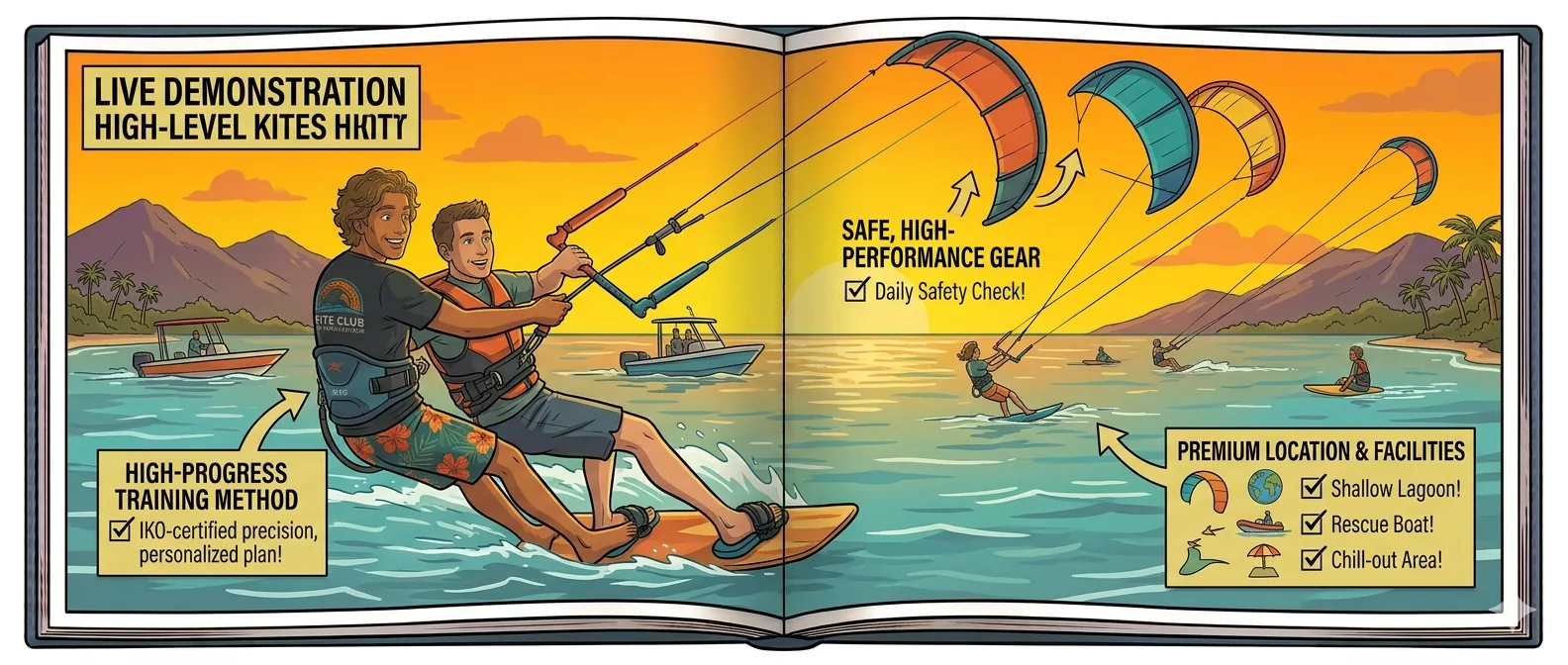
For kitesurfing, look for IKO; for wing foiling, IWO. A certified school follows a structured syllabus and records your student level so you can continue elsewhere. Do not just take a logo on a website at face value: ask which organisation certifies the instructor who will actually teach you.
2. How many students share one instructor
On the water, fewer is safer and faster. At Kite Club the maximum is two students per instructor, and private lessons are one to one. Our instructors, Sergei and Abdulla, are both IKO Level 3. If a school cannot tell you its ratio clearly, keep asking until it does.
3. The safety briefing and release practice
Before your first real kite goes up, you should have practised the quick release on land until it is automatic, and you should know the signals your instructor will use. A school that skips this to get you "in the water faster" is saving its own time, not yours.
4. Equipment that fits you and the day
Kites come in different sizes for a reason. Ask how the school chooses a kite and board for your weight and the wind on the day, and have a look at the gear before the lesson. Well-kept equipment is a good sign of a well-run school in general.
5. Communication on the water
Once you are a few metres out, shouting stops working. Ask how the instructor will talk to you or guide you when you are in the water, whether through radio helmets, agreed hand signals or staying close. Any good school will have a clear answer. At Kite Club you wear a radio helmet, so your instructor talks you through every run in real time.
6. A fair plan for calm days
Wind is not guaranteed on any given day. Find out what happens when it drops: is the lesson moved, and to when? At Kite Club the lesson is rescheduled to the next suitable window rather than run in poor conditions.
IKO Levels From the Student Side
Much of the talk about IKO focuses on instructor ratings, but the part that affects you most is the student level system. As you progress, your level is recorded, and that record travels with you. It lets another IKO centre, on Samui or anywhere else, see what you can already do and continue from there instead of starting again.
- Discovery stage — understanding the wind, flying the kite safely, first body drags.
- Beginner stage — body dragging with purpose, water starts and your first rides (Kite Club's Full Beginner course covers IKO Level 1–3).
- Independent stage — riding upwind, launching and landing on your own, self-rescue and reading conditions (the Independent course covers Level 3–4).
When you compare schools, ask how and when your level will be recorded. It is a small detail, but it shows whether the school treats your course as part of a longer progression.
Want Straight Answers?
Kite Club Koh Samui · Lamai Beach (Dec–Apr) · Nathon Beach (May–Oct)
Questions to Send Before Booking
You can learn a lot about a school from how it answers a short WhatsApp message. Send the same questions to each school you are considering and compare the replies:
- "Which beach will you teach on during my dates?" — on Samui, the answer should depend on the season.
- "Who certifies your instructors, and which organisation will record my level?" — you want a specific answer, not a general "yes, certified".
- "How many students per instructor in the water?" — a number, not a range.
- "What is included in the price?" — equipment, protective gear, the level record.
- "What happens if there is no wind on my lesson day?" — a clear rescheduling policy.
- "Can I be taught in my language?" — instructions are easier to follow in the language you think in.
A school that replies quickly, clearly and without pressure is usually the same on the beach.
Warning Signs on the Beach
- No one can tell you which organisation certifies the instructors
- Several students attached to one instructor in the water at the same time
- A kite goes up before you have practised the safety release
- Promises that you will be riding confidently after a single short lesson
- Lessons carried on in gusty, offshore or clearly unsuitable wind
- Vague or irritated answers to direct questions about safety
None of these automatically mean a school is dangerous, but each deserves a follow-up question. Your first hours of kiting build habits that stay with you for years.
Reading Prices Sensibly
The cheapest lesson is rarely the best value, and the most expensive is not automatically the best either. Compare what you actually get: hours with an instructor, how many students share that instructor, whether all equipment is included, and whether your level is recorded.
For reference, Kite Club Koh Samui charges 5,000 THB for the Discovery lesson (2 hours private or 3 hours in a group), 14,000 THB for the Full Beginner course (6 hours private or 9 hours in a group) and 20,000 THB for the Independent course (10 hours private or 15 hours in a group). All kitesurfing equipment is included. You can see the details on the kitesurfing school page.
When a price looks unusually low, ask what is different. When it looks unusually high, ask what the extra pays for. Either way, a good school will explain.
How Kite Club Koh Samui Answers These Questions
We are obviously not neutral here, so rather than tell you we are the best, here are our answers to the questions above. Hold us to them.
- Where — Lamai Beach from December to April, Nathon Beach from May to October. Lessons, rental, storage, e-foil, SUP and kayak all move with the season.
- Certification — IKO for kitesurfing and windsurfing, IWO for wing foil. Your level is recorded as you progress.
- Ratio — private lessons are one to one; group lessons are a maximum of two students per instructor.
- Included — kite, bar, board, harness, helmet and impact vest.
- Calm days — lessons move to the next suitable wind window.
- Languages — English, Russian, Arabic, German and Ukrainian.
If you are also visiting the neighbouring island, our sister school Kite Club Koh Phangan runs the same IKO courses, so you can continue your progression there.
Matching the School to Your Trip
The right school also depends on how you travel. A few typical situations:
- Short stay, flying into Samui airport — pick a school teaching near where you sleep. In the December–April season, Lamai or nearby Chaweng keep travel time low.
- Family holiday in Bophut or Fisherman's Village — check travel time to the active beach, and whether non-kiting family members have something to do there, such as SUP or kayak.
- Mid-year trip, arriving by ferry — the ferry pier is at Nathon, right next to the May–October kite beach.
- Returning rider — tell the school your recorded level and what you last practised, and ask how they will pick up from there.
Think about the lesson format as well. Private lessons suit people who want every minute of feedback or who tire quickly in the heat; group lessons, with two students sharing one instructor, are longer and suit couples or friends who enjoy learning together. At Kite Club both cost the same per course, so the choice is about how you learn rather than what you pay.
Finally, trust your impression of the first conversation. If the school asks about your swimming, any injuries, your dates and what you hope to achieve before quoting a course, it is thinking about your progress. If the reply is only a price list, ask a few of the questions above and see how the conversation changes.
Related Articles
Sergei · Head Instructor
Founder & Head Instructor · Kite Club Koh Samui
Yes, I run one of the schools you may be comparing, so read this with that in mind. The checklist works for any school on the island, ours included: ask the questions, compare the answers, and choose the place that gives you clear ones.
FAQ
Ask which organisation certifies the instructor who will teach you (IKO for kitesurfing, IWO for wing foil) and how your student level will be recorded. A certified school will answer specifically and without hesitation.
The wind changes coast with the monsoon. From December to April it favours the east coast, where Kite Club teaches at Lamai Beach; from May to October it favours the west coast, where the school moves to Nathon Beach.
At Kite Club, private lessons are one student per instructor and group lessons are a maximum of two students per instructor. Be cautious of any set-up with more students per instructor in the water.
The lesson should be moved to the next suitable wind window rather than run in poor conditions. Ask each school about this before you book.
Book with Koh Samui's IKO Certified School
Kite Club Koh Samui · Lamai Beach (Dec–Apr) · Nathon Beach (May–Oct) · +66 99 312 9042
Book via WhatsAppWhy Detailed Reviews Beat Star Ratings
Online ratings are a useful first filter, but a row of five stars tells you only that people were happy, not why. When you read reviews of kite schools on Samui, look for the ones that describe specifics: how the instructor explained the wind window, whether the safety release was practised before the first launch, how the school handled a day without wind, and whether the student left with a recorded level. Reviews that mention the same instructor by name over several seasons suggest a stable team. Reviews that talk about being moved to a better window instead of struggling in poor wind suggest a school that puts learning first.
Pay attention to the negative reviews too, and especially to how the school replied. A calm, factual answer to a complaint says more about how you will be treated than any number of glowing comments. And remember that one bad day with no wind is not a sign of a bad school; how the school dealt with it is.
Instructor Advice
Ask the school to describe your first lesson step by step. A clear answer that starts on the sand with the wind window and safety release, and only then moves to the water, is exactly what you want to hear.
A Five-Minute Check on Arrival
Even after booking, take five minutes at the beach before your first lesson. Look at how the teaching area is laid out and whether there is space between students. Watch how the instructors set up the kites and check lines. Notice whether students in the water are closely supervised. Ask your instructor to show you the release system and tell you the signals you will use. If everything you see matches what you were told by message, you can relax and focus on learning. If something feels off, say so; a good school welcomes the question.
Whether you land at Samui airport for a week in Lamai during the north-east monsoon or arrive on the ferry at Nathon for a mid-year trip, the same principle applies: choose the school that answers your questions clearly and teaches where the wind is right for your dates. To ask us yours, message Kite Club Koh Samui on WhatsApp at +66 99 312 9042.