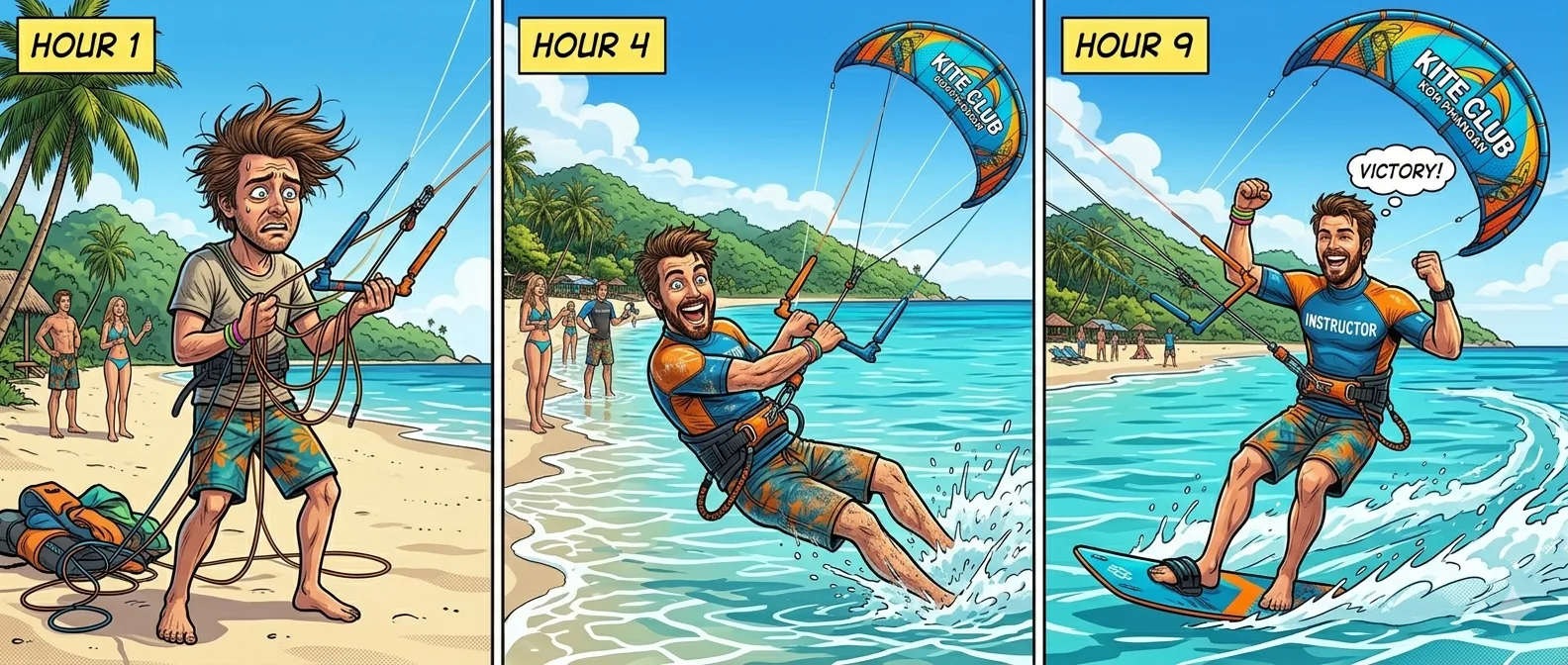
Short answer: a couple of hours to feel what the sport is about, and several lesson days to ride on your own. The longer answer depends on the wind, your body, your head and how you plan the trip. Here is how it usually plays out on Samui.
📖 15 min read · Updated May 2026 · By Sergei Sharvarok · Founder & Head Instructor
Contents
- Think in Hours on the Water
- The Milestones Every Kite Student Passes
- Which Course Covers Which Stage
- Wing Foiling: A Different Clock
- What Speeds People Up
- What Slows People Down
- Samui's Seasons and Your Timeline
- Plans for 3, 5, 7 and 10 Days
- When Progress Stalls
- Life After the Course
- A Worked Example: Five Days in February
- Signs You Are Ready to Ride Alone
- Frequently Asked Questions
Think in Hours on the Water
People usually ask "how many days?", but days are a poor unit for a wind sport. A day with a steady 15 knots at Lamai might give you two productive hours; a day with patchy wind might give you none. What moves you forward is time on the water with an instructor, in suitable conditions. So the honest way to answer is in hours, then turn those hours into days for your particular trip.
Our courses are built the same way. A Discovery lesson is 2 hours private or 3 hours in a group of two. The Full Beginner course is 6 hours private or 9 hours group. The Independent course is 10 hours private or 15 hours group. Group lessons run longer because you share the kite with another student and rest while they fly.
Rule of Thumb
Private hours are denser than group hours, not better or worse. A private student flies the kite for the whole lesson; a group student gets breaks to watch, recover and learn from their partner. Pick the format that suits your budget and your energy.
The Milestones Every Kite Student Passes
Whatever the timeline, every beginner goes through the same sequence. Knowing it in advance helps, because the middle part can feel slow even when you are doing well.
| Milestone | What it looks like | Covered in |
|---|---|---|
| 1. Safety and set-up | Wind window, launching and landing, the quick-release system, how the bar depowers the kite | Discovery |
| 2. Flying with confidence | Steering smoothly, keeping the kite at the edge of the window, figure-eights without staring upwards | Discovery |
| 3. In the water without a board | Body dragging downwind and across the wind, relaunching the kite from the water | Discovery / Beginner |
| 4. Board start | Putting the board on your feet with the kite parked, then a controlled power stroke | Beginner |
| 5. First rides | Short rides that end in a fall, then longer ones with a controlled stop | Beginner |
| 6. Staying upwind | Riding in both directions, holding your ground, walking back less | Independent |
| 7. Self-sufficiency | Choosing a kite size, reading the conditions, self-rescue, riding without supervision | Independent |
Milestones 3 and 4 are where most students feel stuck. Body dragging does not look like kitesurfing, and the first board starts are mostly falls. That is normal. The kite skills you build here are what make the later stages quick.
Which Course Covers Which Stage
| Course | Price | Private | Group (2 : 1) | Where most people end up |
|---|---|---|---|---|
| Discovery | 5,000 THB | 2 h | 3 h | Flying the kite with control, first body drags; a clear idea of whether you want more |
| Full Beginner | 14,000 THB | 6 h (3 × 2 h) | 9 h (3 × 3 h) | Water starts and first short rides for many students |
| Independent | 20,000 THB | 10 h (5 × 2 h) | 15 h (5 × 3 h) | Riding both ways, staying upwind, the skills to practise on your own |
| Refresh | 3,500 THB | 2 h | — | For riders returning after a break, or checking skills before renting |
If you want to leave the island riding on your own, book the Independent course and treat it as the target. If you are unsure whether kitesurfing is for you, start with Discovery; the rest can be decided on the beach. Either way, the course count is in lesson hours, so a day lost to no wind simply moves the lesson — you do not lose the hours.
Wing Foiling: A Different Clock
The site title mentions wing foiling for a reason: many visitors are choosing between the two. The timeline feels different because the equipment is different. There are no lines and no kite in the sky, so the safety and launch stage is shorter. The hard part comes later: balancing on a foil that lifts the board out of the water.
| Wing course | Price | Hours | Typical outcome |
|---|---|---|---|
| Intro (1 lesson) | 4,000 THB | 2 h | Handling the wing, first moves on a large board |
| Beginner | 11,900 THB | 6 h (3 × 2 h) | Controlled riding on the board, first foil lifts for many students |
| Advanced | 18,000 THB | 10 h (5 × 2 h) | Longer flights, turning, working upwind |
Kitesurfers and windsurfers often move through the wing stages faster because they already read the wind. Complete beginners should expect the foil to take patience, and they tend to enjoy the early stages more on a calm, moderate day than in strong gusts.
What Speeds People Up
Consecutive days
Lessons on back-to-back days work better than the same hours spread across two weeks. You arrive for lesson two still feeling what you did in lesson one.
Board-sport background
Snowboarders, wakeboarders and surfers find the board stages easier. They still start from zero with the kite, so do not skip the flying practice.
Talking to your instructor
Say what you felt, not just what happened: "I pulled the bar in and the kite dived" is far more useful than "it went wrong". With radio helmets your instructor can respond immediately while you are still in the water.
Steady, moderate wind
Around 12–20 knots with a stable direction is ideal for learning. It is why January to March at Lamai is our favourite window for beginners.
Sleep and water
It sounds dull, but tired, dehydrated students make the same mistake over and over. In the Samui heat a litre of water per session is a sensible minimum.
What Slows People Down
- Rushing to the board. Students who beg to skip body dragging often lose more time later, because every water start fails for kite reasons.
- Fear that nobody talks about. Some anxiety is healthy. Too much makes your movements hesitant. Tell your instructor — the pace can change, and it usually helps a lot.
- Big gaps between lessons. A week off in the middle of a course means a partial restart.
- Booking the last days of the trip. If the wind drops on your final two days, there is no room to reschedule.
Samui's Seasons and Your Timeline
The island has two wind seasons, and we move with them. That has a direct effect on how quickly the hours can be completed.
| When | Where | Wind | Effect on your timeline |
|---|---|---|---|
| January–March | Lamai Beach (east) | NE monsoon, 12–20 kts, most consistent | Easiest period to finish a course on schedule |
| December and April | Lamai Beach | NE monsoon, a little less reliable | Good; keep a spare day or two |
| May–October | Nathon Beach (west, near the pier) | SW monsoon, 10–18 kts, more variable | Afternoons are usually best; allow extra days |
| October–November | Transition | Light and changeable, start of the rains | Not the time to aim for independence |
Local Insight
At Nathon in summer the breeze often builds through the day, so lessons tend to be scheduled for the afternoon. At Lamai in the peak months there is usually more choice. Either way, your instructor picks the slot with the best wind on the day.
Plans for 3, 5, 7 and 10 Days
- 3 days: Discovery on day one; if you love it, start the Beginner course on days two and three and finish it on a later trip. Expect good kite control, not independent riding.
- 5 days: Full Beginner course over the first three or four days, leaving one day spare for wind. Many students reach first rides.
- 7 days: Independent course (5 × 2 h private) starting on day one or two. Two buffer days cover the odd light-wind day.
- 10 days or more: Independent course plus practice time afterwards — with rental once your instructor agrees you are ready (full set from 2,000 THB per hour). This is where skills settle.
If wind is light on a lesson day, use it: an e-foil session (intro 2,000 THB, 30 min) trains the same balance and foot pressure you need on a board, and a SUP hour at 400 THB is a gentle core workout.
When Progress Stalls
| Where you stall | Usual cause | What helps |
|---|---|---|
| Kite keeps diving into the power zone | Too much input on the bar, looking up constantly | Smaller, slower steering; feel the lines instead of watching the kite |
| You drift downwind in body drag | Body flat in the water, kite too low | Turn your body into the wind, lead with one arm, keep the kite higher |
| Water start pulls you over the board | Too much power, kite too high | Smaller, lower power stroke; push through the heels |
| Rides end after a few seconds | Stopped steering the kite once standing | Keep a gentle up-down movement until speed is steady |
| Can only ride one way | Weaker side and less practice | Spend a whole session on the weak direction |
Life After the Course
Finishing a course is a starting line. After it you will want time to practise staying upwind, riding in more varied wind and eventually trying your first small jumps. Plenty of riders keep coming back for a Refresh lesson at the start of each trip, then rent gear for the rest of their stay. If your travels take you to the neighbouring island, our sister school Kite Club Koh Phangan follows the same IKO curriculum.
Instructors Sergei and Abdulla are both IKO Level 3 and teach with radio helmets, so the coaching carries on while you are riding. They will also be honest with you about whether you are ready to ride without supervision.
A Worked Example: Five Days in February
To make the numbers concrete, here is how a typical private Full Beginner course might fit into a short February holiday at Lamai. The details change with the forecast, but the shape is common.
- Day 1 — arrival. Fly into Samui airport around midday, 30 minutes by taxi to Lamai, check in, walk the beach and message the school to confirm the first slot.
- Day 2 — lesson 1 (2 h). Safety, set-up and flying. By the end you steer the kite without watching it all the time, and you have tried your first body drag.
- Day 3 — lesson 2 (2 h). Body dragging in both directions, relaunching the kite, retrieving a lost board. Arms and shoulders will feel it in the evening.
- Day 4 — light wind. No lesson. A 30-minute e-foil intro in the morning, Fisherman's Village in the evening.
- Day 5 — lesson 3 (2 h). Board starts. Many falls, then a few metres of riding, then a few more. You leave the beach tired and happy.
At that point the student either books more hours to reach the Independent level, or flies home knowing exactly where to pick up next time. Both are good outcomes. The mistake would have been to book the lessons for days 4 and 5 only.
Signs You Are Ready to Ride Alone
"Independent" is not a feeling; it is a list of things you can do reliably. Before an instructor signs you off to practise on your own, they want to see that you can:
- Assess the wind yourself and say whether it is suitable for your level today.
- Set up, launch with a helper and land the kite safely, and explain the right-of-way rules.
- Start, ride and stop in both directions, and get back to roughly where you started.
- Use the quick-release and perform a self-rescue in deep water.
- Recognise when conditions are getting too strong and come in before it becomes a problem.
If one of these is still shaky, a couple of extra supervised hours are cheaper than an accident or a lost kite. Your instructor will tell you plainly what is missing.
Frequently Asked Questions
How many hours does it take to ride a kite on your own?
It varies from person to person. Our Independent course is 10 hours private or 15 hours group and is designed to get you riding both ways and staying upwind. Some students get there sooner, others need a few extra hours of practice afterwards.
Can I learn to kitesurf in a weekend on Koh Samui?
You can do a Discovery lesson (2 hours private or 3 hours group) and learn to fly the kite with control and body drag. Riding independently in a weekend is not realistic for most people.
Is wing foiling quicker to learn than kitesurfing?
The first stage is quicker because there are no lines to manage, and the 2-hour intro gets you moving on a large board. The foil itself takes patience, so the total time to independent riding is not necessarily shorter.
Is a private or group course faster?
Private lessons pack more flying time into each hour, so the course is shorter (6 h vs 9 h for Beginner). Group lessons are longer, include rest breaks and let you learn by watching your partner. The price is the same for both formats.
Which months are best if I want to finish a course on schedule?
January to March at Lamai Beach, when the NE monsoon is most consistent. December and April are also good. From May to October we teach at Nathon Beach, where the wind is more variable, so plan spare days.
I am 50 and have never done a board sport. Is it too late?
No. There is no upper age limit. Older beginners may need a few more hours, but patience and careful listening make up for a lot. Reasonable fitness and being comfortable in the water matter more than age.