Contents
Included in Every Kitesurfing Lesson
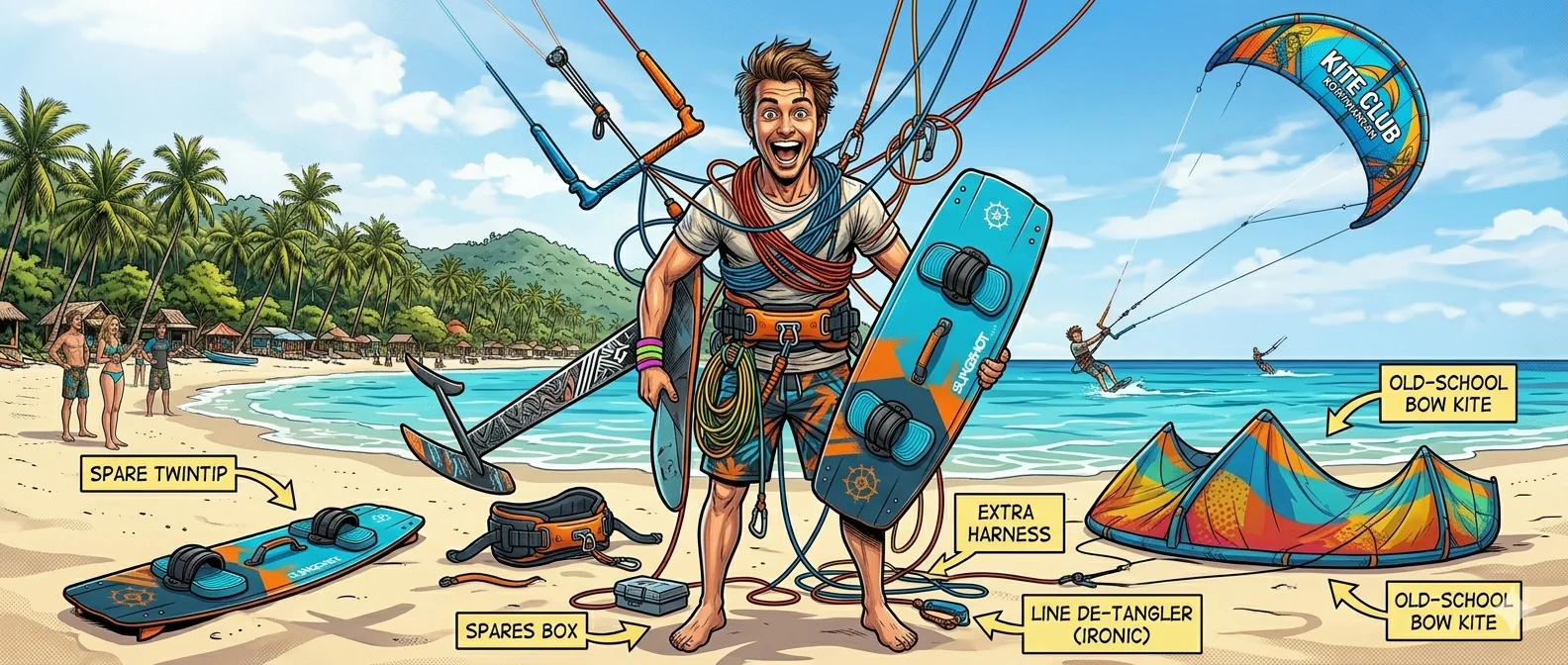
Whether you book a single Discovery session or the full Independent course, you turn up at the beach and the kit is waiting. Nothing is charged on top of the course price for gear.
| What you get | Why it matters for a beginner |
|---|---|
| Kite, chosen for your weight and the day’s wind | Too big and it overpowers you; too small and it will not pull you out of the water |
| Control bar with lines and quick-release | Your steering wheel, brake and emergency stop in one |
| Twin-tip board for learners | Extra width and float make the first waterstarts much easier |
| Harness fitted to you | Transfers the kite’s pull to your body, so your arms only steer |
| Radio helmet | Protects your head and lets the instructor coach you live from the beach |
| Impact vest | Adds buoyancy and softens falls |
| IKO certification for the level you reach | An internationally recognised record of your skills |
You will not be asked to choose sizes or set anything up on your own until the course teaches you how. Part of every lesson is learning to rig and check the equipment yourself, because one day you will do it without an instructor.
Your Kite: Why the Size Changes Day to Day
Kites come in sizes measured in square metres, and there is no single “beginner size”. The instructor looks at two numbers — your body weight and the wind speed — and picks accordingly. A light rider on a gentle day needs more kite area to feel any pull; a heavier rider on a strong day needs less.
On Samui this matters because conditions vary with the season. At Lamai, where we teach from December to April, the north-east monsoon typically brings 12–20 knots and is at its steadiest from January to March. At Nathon, our spot from May to October, the south-west wind is usually lighter, around 10–18 knots, and more changeable. The same student can easily use two different kite sizes on two consecutive days.
All lesson kites are inflatable “LEI” kites. They float on the water, relaunch reliably and are the standard teaching kite worldwide.
The Bar: Steering, Power and the Red Handle
The bar is connected to the kite by four lines. Turning the bar like a bicycle handlebar steers the kite; sliding it away from you reduces power, pulling it in adds power. That push–pull habit is one of the first things you will practise.
More important still are the safety systems:
- Quick-release: one push or pull on the release handle disconnects you from the main power of the kite, which drops to the water.
- Safety leash: keeps you attached to one line so the kite stays depowered and does not fly away after a release — and it has its own release as a last resort.
You will use both on land before you ever touch the water, and your instructor will check that everything works at the start of each session.
The Board and the Harness
Learners ride larger twin-tip boards: wide, buoyant and forgiving if your feet are not quite in the right place. Footstraps are set up for you. As your riding improves, usually during the Independent course, you may switch to a smaller board that carves and edges better — but only when you are ready.
The harness is what makes kitesurfing possible for people without gorilla arms. Clipped into the harness, the pull of the kite goes through your hips and core instead of your hands. We fit it before your first session and adjust it whenever needed.
Helmet, Vest and Radio Coaching
Every student wears a helmet with a built-in radio receiver. From the beach the instructor can say “turn the kite left”, “sit back” or “look where you want to go” at the exact moment it is needed. Instead of waiting until you are back on the sand to hear what went wrong, you get the correction during the attempt itself, which saves a great deal of time in the waterstart phase.
The impact vest is not a full life jacket, but it adds buoyancy and some protection when you fall. Safety during lessons comes from constant instructor supervision, the radio link and beach support — combined with conservative kite choices on your early days.
What to Put in Your Own Bag
The list is short:
- Swimwear that stays on when you are dragged through the water. Tight-fitting beats loose.
- A rash vest with long sleeves. Two hours in the tropical sun on reflective water is more than most people expect.
- Sunscreen, applied before you arrive so it has time to set, plus lip balm.
- Sunglasses with a strap for watching from the beach — you will take them off in the water.
- Drinking water and a snack for breaks.
- Water shoes if you like — optional, but comfortable on hot sand or rocky patches.
Things to leave at home: jewellery, expensive watches and anything you would not want to lose in the sea.
If you wear glasses, tell your instructor before the lesson. Contact lenses work for many riders, although you will spend some time with your face in salt water, so daily disposables are the practical choice. Long hair is best tied back firmly — loose hair and kite lines do not mix. And if you have an old pair of thin gloves, you can bring them, but most people find they are not needed: once you are in the harness, your hands are only steering, and the bar grip is designed to be comfortable without them.
Gear for Our Other Sports
Kitesurfing is not the only thing we teach, and the same “everything included” rule applies elsewhere:
- Wing foil lessons: the wing, a stable foil board, the foil itself, helmet and impact vest. Courses follow the IWO system.
- E-foil sessions: the electric board and remote, helmet, vest and radio, with an instructor. Open from age 12 (parental consent under 18).
- Windsurfing lessons: board, complete rig and vest, taught along IKO lines.
- Kayak and SUP rental: boat or board, paddle and a buoyancy vest on request.
FAQ
Yes. Kite, bar and lines, board, harness, radio helmet and impact vest are all included in every Kite Club Koh Samui lesson and course. You only need swimwear and sun protection.
No. Wait until you have finished at least the Beginner course. By then you will know which sizes and board type suit your weight and style, and buying too early often means buying the wrong gear.
You can bring your own harness if it fits well; the instructor will check it. A wetsuit is not needed — the water around Samui is warm all year. A long-sleeved rash vest is more useful.
Yes, once you ride independently. A full kite set (kite, bar, board and harness) costs 2,000 THB for 1 hour, 3,500 THB for 2 hours, 4,500 THB for 3 hours or 5,000 THB for a full day.
The equipment is the same; the kite size we choose is not. Nathon’s south-west wind is usually lighter than Lamai’s, so on the west coast you will often fly a larger kite.
Book a Lesson — Gear Included
Kite Club Koh Samui · Lamai Beach (Dec–Apr) · Nathon Beach (May–Oct) · Just bring swimwear and sunscreen
Book via WhatsAppHow Gear Changes as You Progress
Equipment is not fixed for the whole course. It follows your level, and seeing how it changes is a good way to understand what each course is for.
Discovery lesson — 5,000 THB
Most of the time goes into kite control, so the key piece of equipment is the kite and bar. You start on the sand with a small trainer kite and then fly a full-size inflatable kite with the instructor next to you. If there is time and the conditions allow, you move into the water and feel the kite pulling you. Sessions are 2 hours private or 3 hours in a group of two.
Full Beginner course — 14,000 THB
Now the board comes into play. You will learn to body-drag back to it, put it on your feet and try your first waterstarts on a large, buoyant learner board. Kite size is still chosen for you, but you will start to hear why a particular size was picked for the day. The course is 6 hours private (3 × 2 h) or 9 hours in a group (3 × 3 h).
Independent course — 20,000 THB
The aim here is riding on your own, holding a course upwind and getting back to where you started. You take over more of the setup — pumping, connecting the lines, pre-flight checks — and you may move to a smaller board once your edging improves. The course is 10 hours private (5 × 2 h) or 15 hours in a group (5 × 3 h).
If you already ride but feel rusty, the 2-hour Kitesurfing Refresh (3,500 THB) is a good way to get your confidence back on our equipment before renting.
Season by Season: Lamai and Nathon
The kit list does not change when the school moves across the island, but the way we use it does. At Lamai, from December to April, the north-east monsoon is fairly steady, particularly from January to March. On those days a mid-sized kite often works for most of a session, and the instructor mainly adjusts for your weight. Mornings can start lighter and the breeze tends to fill in as the day goes on, so a lesson time chosen the evening before is usually reliable.
Nathon, our base from May to October, is a different story. The south-west wind on the west coast is lighter and changes more from hour to hour. Larger kites come out more often, and we sometimes change size during a session when the wind picks up or drops. For students this is actually a good lesson in itself: you see first-hand why riders own more than one kite.
Whichever coast you are on, the sun does not change. Heat and UV are the biggest enemies of equipment in the tropics, which is why kites are not left baking on the sand between sessions — and why we keep reminding you to cover up as well.
Extras With the E-Foil
E-foil sessions come with more than the board. An instructor, helmet, vest and radio are included, and so is a free video filmed on a phone so you can see your first flights. If you want something special, drone footage costs 1,000 THB, or 2,000 THB with editing. It is an optional extra, not something you need to enjoy the session, but a lot of people like having a proper clip of the moment the board lifts out of the water.
Looking After the Equipment With Us
Part of learning is learning to treat gear properly, because one day it will be your own. During lessons you will pick up a few habits that every experienced rider has:
- Never leave an inflated kite unattended on the beach without weighting it down with sand.
- Keep lines off the sand where possible — grit wears them out quickly.
- Walk a launched kite back to the instructor rather than dropping it and running.
- Rinse salt off hardware and hang harnesses in the shade after use.
- Tell the instructor straight away if something looks damaged — a small tear found early is an easy fix.
The tropical sun is hard on fabric, so kites are packed away when they are not being used. Our instructors check the kit before every lesson, and you will learn to do the same checks yourself.
Thinking About Buying Your Own Kit?
Plenty of students leave Samui wanting their own setup. Our advice is to wait until you ride confidently. Riding on the school’s different kite sizes during the course, and then renting for a few sessions, tells you far more about what suits you than any online review. When you are ready, ask the instructors — they will happily talk through sizes for your weight and the wind at your home spot.
Travelling with gear is also something to consider. Many riders who kite only on holiday find that renting a complete set at their destination is simpler than carrying a board bag through airports. On Samui, flights land at Samui International Airport (USM), and a full set from us is ready on the beach whenever you are.