The Evening Before: Packing and a Good Night's Sleep
Lay out a simple kit: swimwear, a long-sleeve rash guard or UV top, reef-safe waterproof sunscreen, sunglasses with a strap if you have them, a hat for the breaks and a big bottle of water. We provide the kite, bar, board, harness, helmet and impact vest, so there is nothing to buy or rent.
Leave the jewellery and the watch at your accommodation, and do not bring anything you would mind getting sandy or wet. Eat a proper meal before you come — two hours of kite flying in the tropical sun burns more energy than people expect, and a hungry student loses focus fast.
If you are staying away from the beach you are learning at — for example in Chaweng or Bophut during the Lamai season — plan your drive so you arrive relaxed and a few minutes early, rather than rushing in straight from the car.
Meeting Your Instructor
The lesson starts with a chat, not with a kite. Your instructor will ask about your swimming, any board or wind sports you have done, and whether you have injuries or worries worth knowing about. Then comes the fitting: harness snug around the hips, helmet with built-in radio, impact vest.
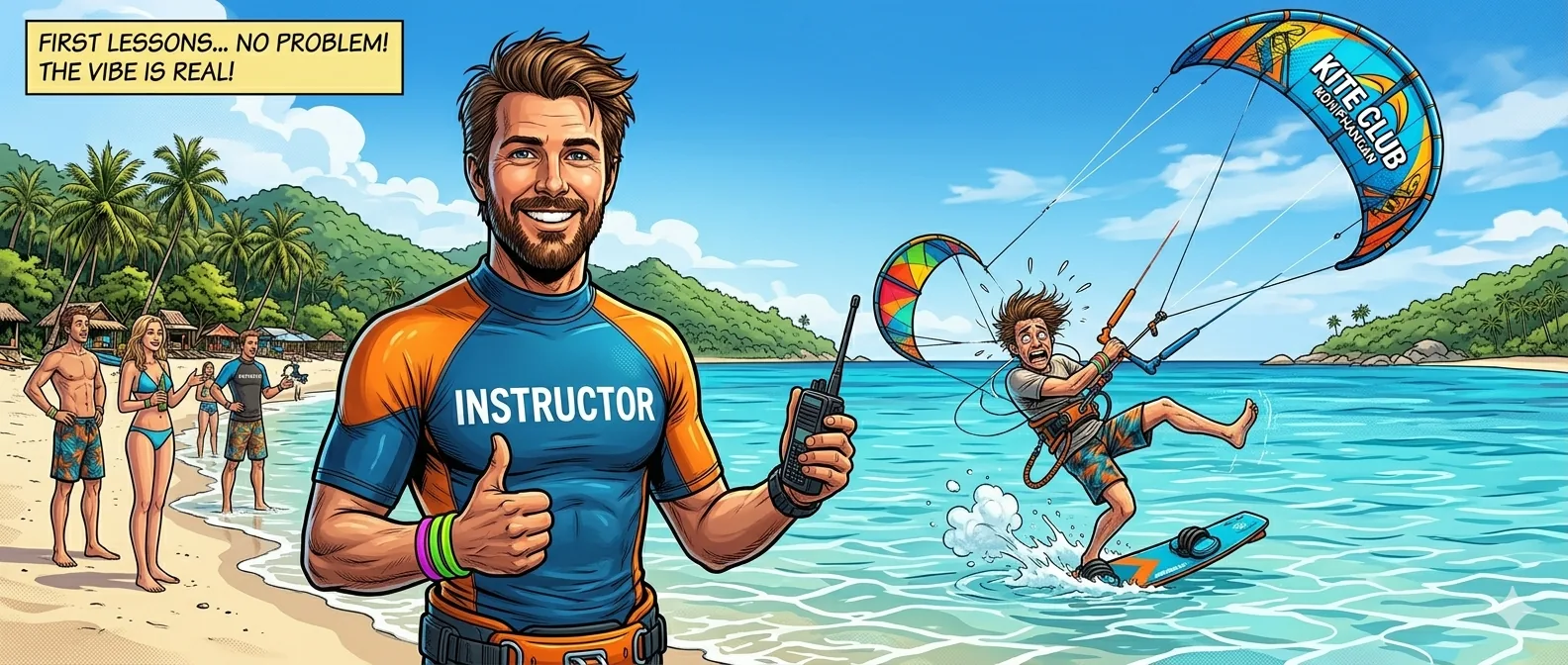
At Kite Club Koh Samui the lessons are taught by Sergei, the founder and head instructor, and Abdulla — both IKO Level 3 instructors. Whoever you get, the approach is the same: short explanations, lots of doing, and questions welcome at any point.
Kite Control on the Sand
Before any water, you learn how the kite behaves. Your instructor draws the wind window in the sand: the edge of the window, where the kite sits quietly, and the centre, where it pulls hard. You find out that pulling the bar towards you adds power and pushing it away takes power off, and — most important of all — how to activate the safety systems so the kite depowers completely.
You will fly the kite in slow, controlled moves while your instructor holds onto you and talks you through each step. Most people are surprised by two things: how quickly the kite responds to small movements of the bar, and how much it pulls when it drifts into the centre of the window. Both are exactly what this part of the lesson is for.
Radio On, Into the Sea
Once your kite control is steady, you walk into the water. From here on your instructor coaches you through the radio in your helmet, so you hear clear, calm instructions even when you are metres apart and the wind is loud. Safety on the water comes from that close supervision and the support team on the beach — the instructor watches every move and tells you straight away what to change.
Body Dragging: Being Pulled on Purpose
Body dragging means letting the kite pull you through the water without a board. It sounds like a detour, but it is how you learn to steer the kite with confidence while you are in the sea — and it is also how you get back to a board you have lost later on. You practise dragging downwind, then with one arm out to the side to change direction.
If the day goes well and there is time left, your instructor may bring the board out so you can feel what it is like to get your feet into the straps with the kite parked overhead. Standing up and riding is the goal of the Beginner course, not of the first session, so do not measure your day by it.
Why the Board Waits
Students sometimes ask why they cannot simply try the board straight away. The answer is that almost every problem on the board is really a kite problem. If the kite dives into the power zone at the wrong moment, you are pulled over the front; if it drifts to the edge, you sink. When kite control is automatic, your attention is free for your feet, your balance and the direction of the board — and the waterstart comes much faster.
That is also why instructors keep coming back to the same few drills: flying the kite with one hand, looking away from it for a few seconds, parking it overhead and moving it again smoothly. They are not exciting, but they are what makes the second and third lessons so much more fun. The time you invest in the kite on day one pays you back on every session after it.
How You Will Feel Afterwards
Tired, salty and usually grinning. The forearms, shoulders and core do most of the work, and a bit of stiffness the next day is normal. Drink plenty of water, stretch your back and hips in the evening, and give yourself a proper night's sleep before the next lesson. Sunburn is the other common souvenir of a first day, so put on another layer of sunscreen whenever you take a break and cover your shoulders once you are out of the water.
Instructor Tip
Before you fall asleep, replay the lesson in your head: where the kite pulled, where it went quiet, what the safety release felt like. That mental rehearsal makes the next lesson start from a higher point.
FAQ
The Discovery lesson costs 5,000 THB and lasts 2 hours as a private lesson or 3 hours in a group of two students with one instructor. All equipment is included.
Probably not, and that is normal. The first lesson is about kite control, safety systems and body dragging. Riding on the board is the goal of the Beginner course.
You wear a helmet with a built-in radio, so your instructor can coach you clearly even when you are some distance apart and the wind is strong.
There is no strict minimum age; children from about 8 years can learn. What matters is body weight — at least 30–35 kg — so that the kite does not overpower them.
We check the forecast and move your lesson to a better day if the wind is too light or too strong. If you are short of time, you can try e-foil, kayak or SUP instead.
Book Your Discovery Session
2-hour Discovery Course · 5,000 THB · all equipment included · Lamai Beach (Dec–Apr) · Nathon Beach (May–Oct)
Book via WhatsAppThe Two Hours at a Glance
Every lesson adapts to the student and the wind, but a typical private Discovery session runs roughly like this:
- First few minutes: introductions, a quick look at the day's wind and the fitting of harness, helmet and vest.
- The first part on land: the wind window, setting up and checking the lines together, launching and landing with your instructor, and trying the safety release yourself.
- The middle of the lesson: flying the kite with more confidence, first on the sand and then standing in shallow water.
- The last part: body dragging downwind and across, plus a first feel for the board if everything is going smoothly.
- The final minutes: a short debrief — what went well, what to focus on next time.
In a three-hour group lesson the same steps are spread out so that both students get their turn with the kite.
Common First-Day Worries
"I am not very fit." You do not need to be. The harness takes the pull of the kite through your hips, not your arms, and the instructor adjusts the pace. Basic fitness helps, but technique matters far more than strength. "I am scared of the kite." That is a healthy respect, not a problem. The first half hour is designed to show you how to control the power and how to switch it off. Most nervous students relax once they have used the safety release themselves. "I am not a strong swimmer." You should be comfortable in the sea, but you wear an impact vest and a helmet, you start in water you can stand in, and your instructor is with you the whole time. Tell us about any worries when you book.Arriving on Samui: Timing Your First Lesson
Samui has its own airport (USM), so many visitors land in the morning and are on the beach by the afternoon. Tempting as it is, try not to book your first lesson on arrival day after a long-haul flight. A night's sleep and a relaxed morning make a real difference to how quickly you pick things up, and they also let you check the forecast and choose the best slot with us.
Private or Group: Two Ways to Spend Your First Day
A private Discovery lesson is two hours with an instructor all to yourself. You get every minute of coaching and every go with the kite. In a group lesson you share one instructor with one other student, and the lesson lasts three hours instead of two, so that each of you gets enough flying time. The price is the same — 5,000 THB — and both formats cover the same material.
Couples and friends often choose the group option because it is fun to learn together and you pick up a lot by watching the other person make — and fix — the same mistakes. If you like full attention, or you are the kind of learner who prefers to go at your own pace, private is usually the better fit.
Lamai in January, Nathon in July
Your first lesson looks slightly different depending on when you come. In the Lamai season, from December to April, the northeast monsoon typically brings 12–20 knots, and from January to March it is at its most dependable. That steady wind is ideal for a first lesson: your instructor can plan the session with confidence and there is usually good wind for most of the day.
From May to October we teach at Nathon Beach on the west coast, beside Nathon town and the ferry pier. The southwest monsoon is lighter and more variable, typically 10–18 knots, and the afternoon is usually the best window. First lessons work very well there too, but your instructor will pick the time of day carefully and may suggest moving a session if the forecast changes.
Realistic Goals for Day One
Here is what a good first lesson looks like: you know where the kite pulls and where it rests, you can move it smoothly from one side to the other, you have used the safety release yourself, and you have been dragged through the water with the kite under control. Some people also get a first feel for the board.
What it does not usually include is riding across the bay. The students who have the best first day are the ones who enjoy each small step instead of racing towards the board.
Planning the Rest of Your Course
If the Discovery lesson convinces you, the Beginner course is the next step: 14,000 THB for 6 hours of private lessons (three sessions of two hours) or 9 hours in a group of two (three sessions of three hours). Leave a day or two between sessions if you can, both for your muscles and for the wind — in the Lamai season it is usually easy to fit three sessions into a week, while at Nathon it is worth planning a little more flexibly.
A Note for Parents
We teach children too. There is no strict minimum age, and kids from around 8 years can start, but body weight matters more than age: a child needs to weigh at least 30–35 kg so the kite does not overpower them. Tell us your child's age and weight when you book, and we will suggest whether a kite lesson makes sense now or whether an e-foil session (from age 12), a kayak or a SUP is the better choice for this trip.
Whatever you decide, send us a WhatsApp message with your dates and the part of the island you are staying in, and we will help you plan the first lesson around the best wind.