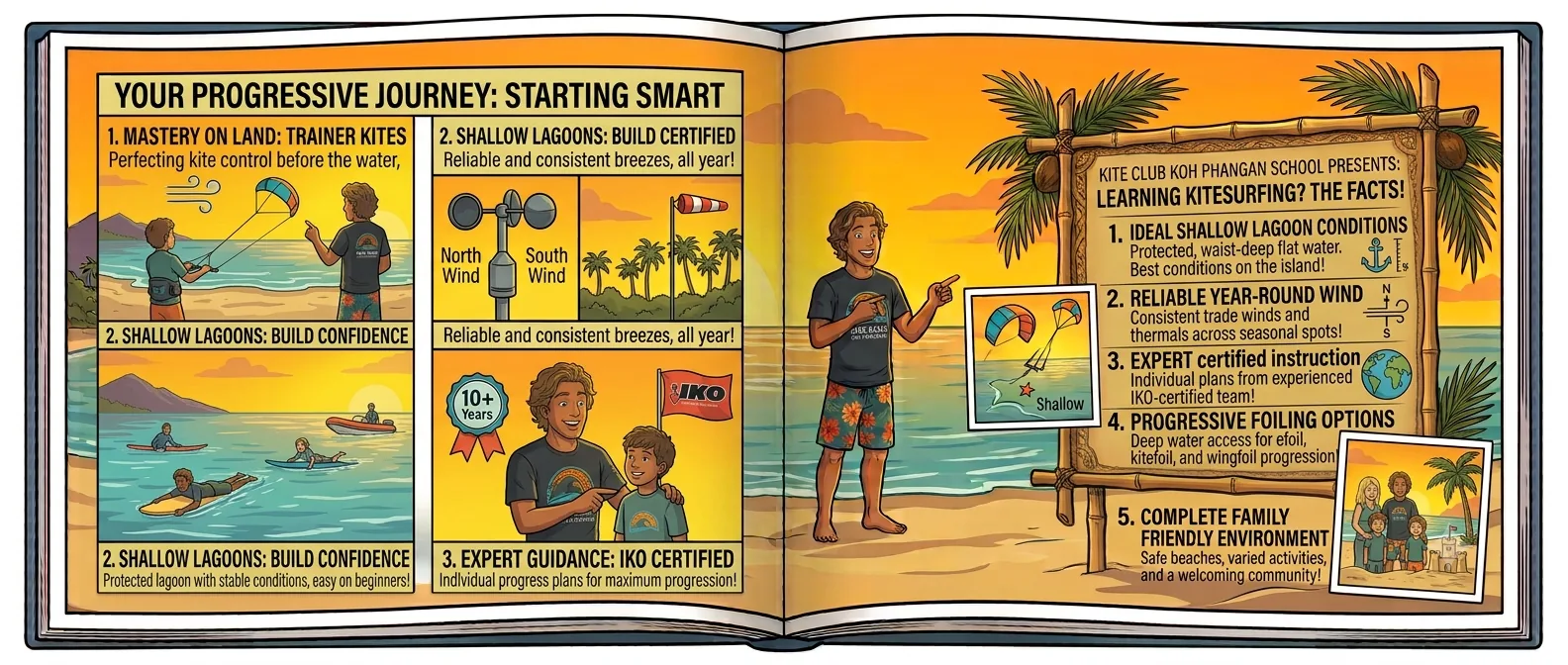
IKO — the International Kiteboarding Organization — is the most widely used teaching standard in kitesurfing. If you learn with an IKO school, you get a rider card that other IKO centres around the world recognise. Here is what that means in practice, and how our courses on Samui map onto it.
📖 3 min read · Updated September 2026 · By Sergei Sharvarok · Founder & Head Instructor
What IKO Actually Is
IKO trains and certifies instructors and publishes a step-by-step curriculum that member schools follow. For you as a student it means two things: the lesson has a clear structure with the same safety steps everywhere, and your progress is recorded on an IKO rider card (in the IKO app).
The Rider Levels in Plain English
| IKO level | What you can do | Kite Club course |
|---|---|---|
| Level 1 — Discovery | Set up and fly a kite safely, understand the wind window, safety systems, body dragging | Discovery lesson, 5,000 THB |
| Level 2 — Intermediate | Body drag with and against the wind, first water starts, short rides | Full Beginner course, 14,000 THB |
| Level 3 — Independent | Ride both directions, stay upwind, self-rescue, launch and land on your own | Independent course, 20,000 THB |
| Level 4 and up | Transitions, jumps, and later strapless or foil disciplines | Pro Lesson and Hydrofoil Lesson, 5,000 THB each |
Prices and durations for every course are on the kitesurfing lessons page. Lessons are private (1 student per instructor) or in a group of two.
What the IKO Card Is Good For
- Renting gear abroad — most rental centres ask for proof of level before handing over a kite. An IKO card at Level 3 is the most common proof.
- Continuing lessons elsewhere — the next IKO school can see what you already did and continue from there instead of starting over.
- Supervised riding — some spots only allow independent riding for certified riders.
Your card shows the last level signed off by an instructor. If you have had a long break, a 2-hour refresh lesson (5,000 THB) is usually enough to get back to where your card says you are.
Learning IKO on Koh Samui
Our head instructor Sergei and co-founder Abdulla are both IKO Level 3 instructors and coach through radio helmets, so corrections reach you while you are riding. The school runs at Nahai Beach from December to April and at Nathon Beach from May to October. There is no strict minimum age — what matters is a minimum body weight of about 30–35 kg so the kite cannot overpower the rider.
Nahai has shallow, flat water with no waves along a 2 km beach — ideal for the Level 1–2 stage, when you spend a lot of time standing up in the water with a kite in the air.
Frequently Asked Questions
Is IKO certification recognised worldwide?
IKO is the largest kiteboarding teaching organisation, and its rider card is widely accepted by schools and rental centres in many countries.
How long does it take to reach IKO Level 3?
It depends on wind and the student. On Samui our Independent course is 10 hours private or 15 hours in a group of two, after the beginner stage.
Do I get the card after the Discovery lesson?
Your progress is recorded from the first lesson. The card shows the level your instructor signs off.
Which languages do you teach IKO courses in?
English, Russian, Arabic, German and Ukrainian.
Start at IKO Level 1
Book the 2-hour Discovery lesson and get your first sign-off on the IKO card.
💬 WhatsApp +66 99 312 9042